Monthly Archives: November 2026

More House Races Called

Up-to-the-minute interactive 2026 election results: FOX News

By Jim Ellis — Thursday, November 5, 2026

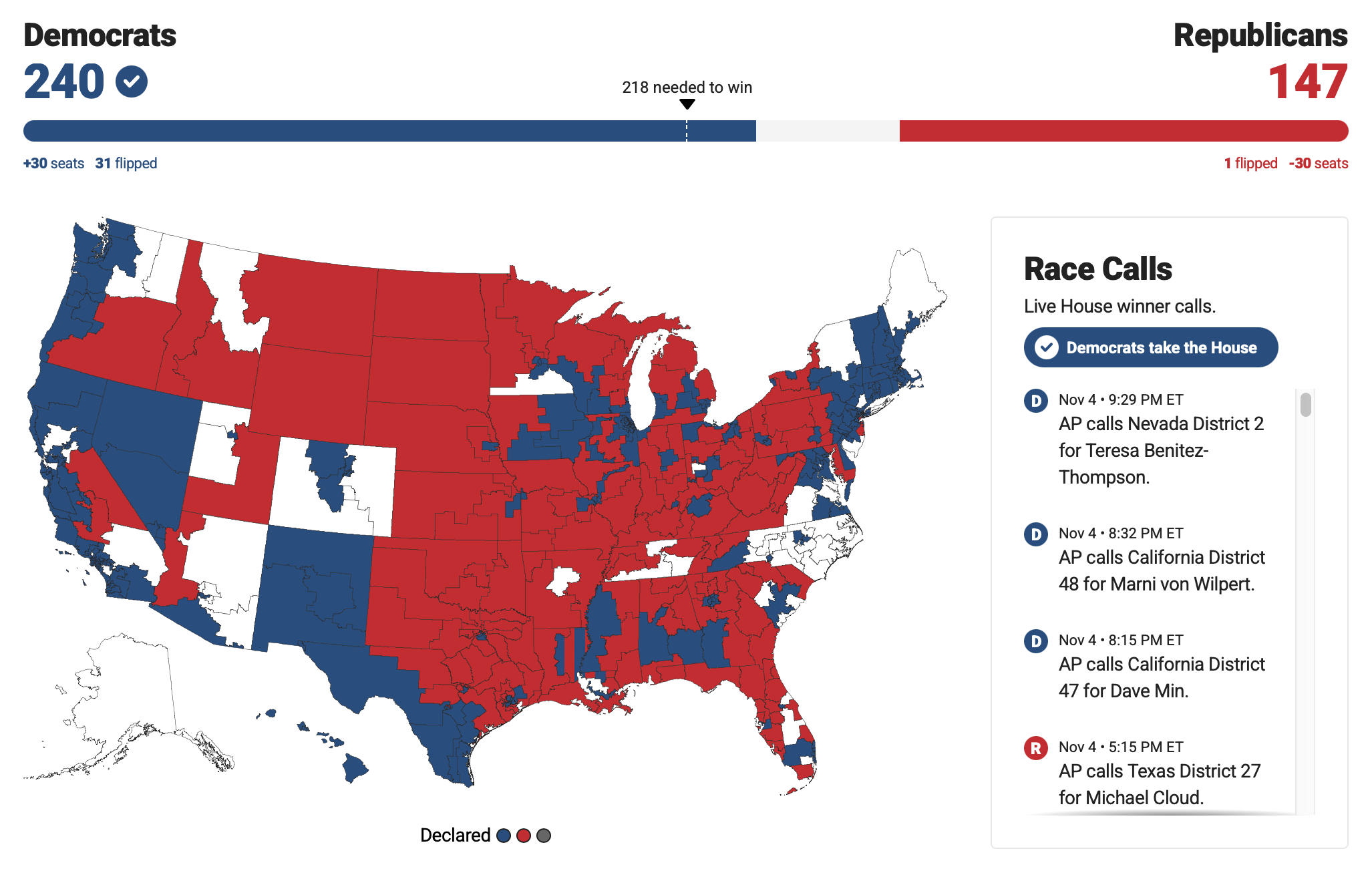
While we still see 23 officially uncalled races, there is a strong idea as to how the House party division will settle. With the information currently available, the House is forecast to break 256D – 179R, giving the Democrats a huge majority with which to work.

Several new races have been called since election night. They are:

• CA-11: Rep. Nancy Pelosi (D-San Francisco) will be succeeded by state Sen. Scott Wiener (D-San Francisco) who defeated San Francisco County Supervisor Connie Chan (D) in a double-Democratic general election.

• CA-34: Local Town Councilwoman Angela Gonzales-Torres (D) defeated US Rep. Jimmy Gomez (D-Los Angeles) in another double-Democratic general election. Neither the Wiener nor Gonzales-Torres victories change the partisan division.

• FL-7: Former news anchor Ryan Elijah (R) will go to a recount against former NASA Chief of Staff Bale Dalton (D). Elijah leads the final count by 1,701 votes, which likely falls into the Florida automatic recount margin.

• ME-2: Former Gov. Paul LePage (R) has declared victory over Democrat Matt Dunlap. He has a 1,830 vote lead with the remaining uncounted votes coming largely from areas where he performed strongly. This would be counted as one of the four Republican conversion seats.

• MI-4: St. Sen. Sean McCann (D-Kalamazoo) unseated Rep. Bill Huizenga (R-Holland) with an official 50.1 – 48.3% margin.

• MI-7: Democrat William Lawrence officially unseated freshman Rep. Tom Barrett (R-Charlotte) by a 51-48% split.

• MI-10: In the open seat that Rep. John James (R-Farmington Hills) risked to run unsuccessfully for Governor, Democrat Christina Hines outpaced Republican Michael Bouchard, Jr. with 52.4% of the vote. The three Michigan races just called are all Democratic conversions.

• MT-1: Smokejumper firefighter Sam Forstag (D) has officially defeated Republican radio talk show host Aaron Flint with an even 50% of the vote to convert the open western 1st District for his party.

• NV-2: In another Democratic flip, former state House Majority Leader Teresa Benitez-Thompson defeated controversial Republican David Flippo with an official 50.3 – 44.4% split.

• NJ-2: The second New Jersey Republican House incumbent to lose on Tuesday is veteran Rep. Jeff Van Drew (R-Dennis Township). He conceded the race to Cape May Mayor Zach Mullock (D) with a 50.8 – 48.2% spread.

• NY-21: Businessman Anthony Contantino (R) has clinched his victory over Democratic dairy farmer Blake Gendebien. This keeps the open 21st District of Rep. Elise Stefanik (R-Schuylerville) in the Republican column.

• OH-10: The third Republican Ohio congressional seat loss is from veteran Rep. Mike Turner’s (R-Dayton) 10th District. He lost the seat to nurse and US Air Force veteran Kristina Knickerbocker (D) by a margin of 4,938 votes.

• SC-1: Sen-Elect Annie Andrews’ (D) strong showing in her home area of Charleston was able to pull Democratic open seat congressional candidate Nancy Lacore, a retired Navy Vice Admiral, to a tight victory over Republican Jenny Costa Honeycutt to convert the 1st District to the Democratic column.

• TN-9: Republican state Sen. Brent Taylor (R-Memphis) has been declared the winner of the new 9th District and is one of the rare Republican redistricting victories of this election cycle.

• TX-2: State Rep. Steve Toth (R-The Woodlands), who defeated Rep. Dan Crenshaw (R-Humble) in the 2026 Republican primary has now officially secured the seat in the general election.

• TX-9: In another redistricting defeat for the Republicans, Democratic former Houston City Council aide Letty Gutierrez (D) defeated Republican Alex Mealer to claim the newly created 9th District, which was designed to elect a GOP candidate.

• TX-32: A Republican redistricting victory occurred in north Texas as businessman Jace Yarbrough claimed the new 32nd District in an open seat campaign. This represents the Republicans’ lone redistricting victory in the state.

• TX-38: As expected, mortgage broker Jon Bonck (R) secured the open seat that Rep. Wesley Hunt (R-Houston) vacated to run unsuccessfully for the Senate.

• WA-4: Though many votes remain outstanding, it is clear that Yakima County Commissioner Amanda McKinney (R) will succeed retiring Rep. Dan Newhouse (R-Sunnyside) in the state’s safest Republican seat.

Reps. Nick LaLota (R-NY-1), Anthony Garbarino (R-NY-2), Lance Gooden (R-TX-5), Blake Moore (R-UT-2), and John McGuire (R-VA-5) have all secured re-election. Trevor Nehls (R-TX-22) will succeed his retiring twin brother, Troy Nehls (R-Richmond) in the district just south of Houston.

Reps. Darren Soto (R-FL-9), Brad Finstad (R-MN-1), Greg Murphy (R-NC-3), Virginia Foxx (R-NC-5), and Scott DesJarlais (R-TN-4), are headed to recounts. Reps. Soto and Murphy have small leads, while Reps. Finstad, Foxx, and DesJarlais all slightly trail.
Democrats Score Huge Victory

Up-to-the-minute interactive 2026 election results: FOX News

By Jim Ellis — Wednesday, November 4, 2026

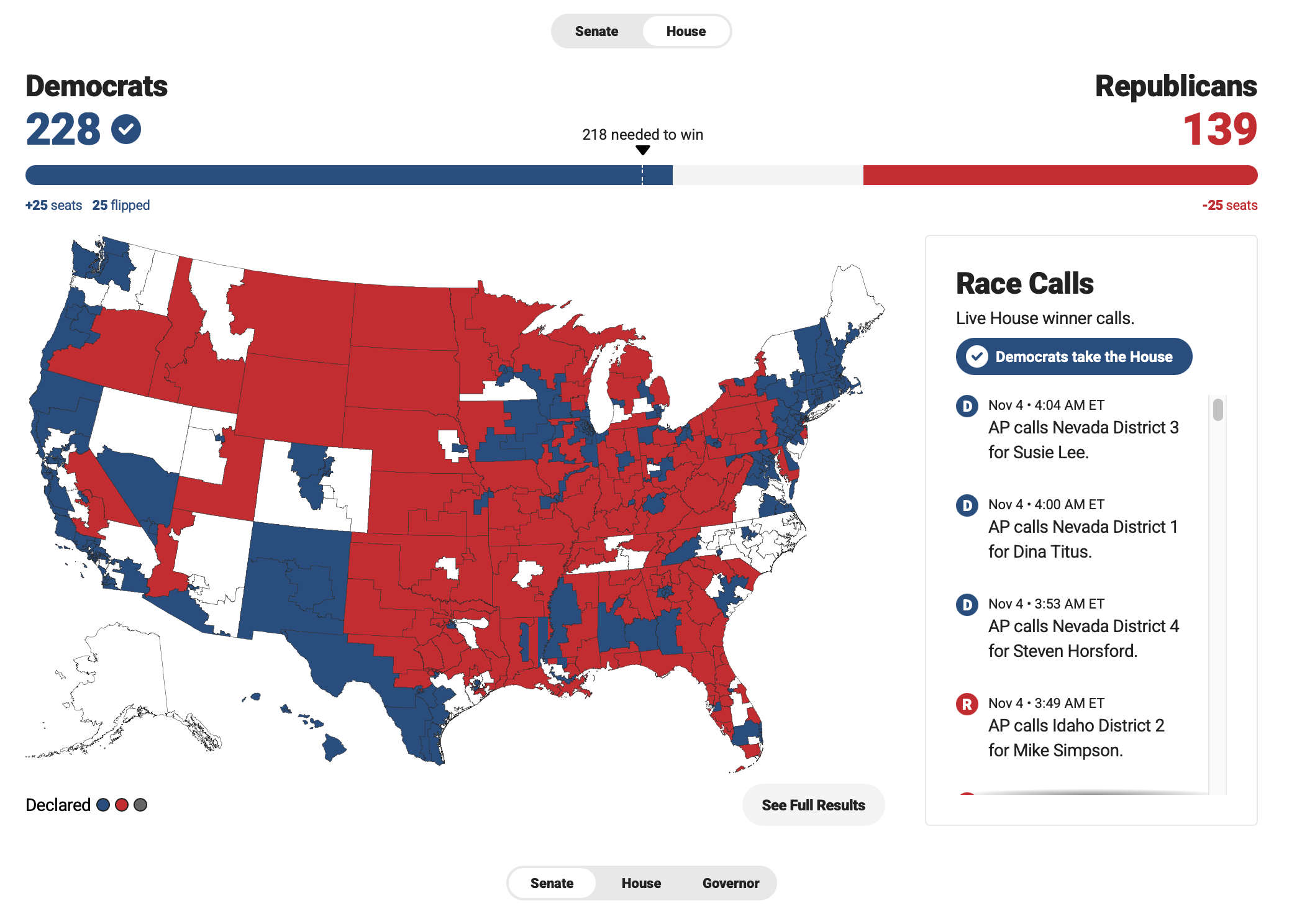
The Democrats scored a wave victory in the 2026 midterm elections last night, capturing both houses of Congress with large margins and likely paralyzing the final two years of the Trump Administration.

The Senate results were the biggest surprise of the evening as all of the battleground states went Democratic. Once again, the Senate races performed in virtually uniform fashion, as they have in every recent wave election.

The party is now assured of 54 seats in the new Senate, and the number could climb to as high as 56 depending upon the outcome of uncalled races in Alaska and Mississippi.

At this point, we see as many as 43 uncalled House races. Democrats are assured of gaining 27 Republicans seats, with at this point, Republicans defeating no Democratic incumbent. Redistricting, which was supposed to give the GOP a chance to mitigate the size of the new majority was a resounding failure as only two of the 13 seats Republicans had hoped to gain in redistricting actually came through. The biggest redistricting failures came in Florida and Texas. The party was expected to gain four in Florida – they gained zero – and five in Texas – they gained one, with one uncalled.

Among the 43 uncalled races, the Democratic candidate leads in 11, and an additional dozen are too close to call. If the Democrats successfully hold their leads in the 11 where they have a clear advantage and at least break even among the remaining toss-up uncalled seats, the majority figure would reach to 258 and could well approach or go beyond 260. Such a large majority will give them the opportunity of holding House control for many successive elections.

Once the results become final, we will be able to judge the actual turnout figures, which will go a long way toward explaining why the electorate fell as it did. We can already see that the polling industry revived itself after going through a difficult series of elections since President Trump was initially elected.

Expect more indepth analysis to be soon forthcoming when races and results become final.

The Point Races

By Jim Ellis — Tuesday, November 3, 2026

Election Day

You can watch Election Day results in a number of locations; NPR is just one of dozens, if not hundreds of spots you can track in real time as election results unfold: NPR Election Results.

Today is Election Day, and there are a number of races we should watch for clues about the developing national trend. Outlined below are key contests that may provide some early answers.

In the Senate, Republicans have a 53-47 majority and are likely to return with a smaller conference if not in the minority. The Democrats need a net gain of four seats to reach the 51 majority threshold. Republicans, as we know, will retain the Senate at 50-50.

The first race to monitor is Michigan, while conceding that the Republican seat in North Carolina will easily go to Democratic former Gov. Roy Cooper. If former Republican Congressman Mike Rogers flips Michigan’s open Senate seat by defeating former Wayne County health director Abdul El-Sayed, Republicans would have a strong chance of preserving their majority.

Democrats can reach 51 seats with a Cooper victory in North Carolina, a hold in Michigan, and wins in three of the following four states: Maine (defeating Sen. Susan Collins), Ohio (defeating Sen. Jon Husted), Texas (capturing the open seat being vacated by Sen. John Cornyn), and Alaska (defeating Sen. Dan Sullivan). If Republicans win any of these contests in addition to Michigan, their majority would likely be secure.

At this point, the Iowa race featuring Rep. Ashley Hinson (R-Marion/Cedar Rapids) and the Nebraska contest involving Sen. Pete Ricketts are both trending Republican. Kansas remains a wild card. Though the polling trajectory resembles both 2014 and 2020, when late surveys showed close races before Republicans ultimately won by 10 and 11 points, respectively, the contest between Sen. Roger Marshall and Democrat Adam Hamilton continues to remain tight.

The final Senate race to watch in the early time zones is Minnesota. The Republican nominee is former national sports media figure Michele Tafoya, who has an outside chance at scoring an upset. As in Michigan, a Tafoya victory would likely ensure continued Republican control of the Senate.

The House appears poised to shift Democratic, but the size of the emerging majority remains uncertain. Among the most important early House races is New York’s 17th District, where two-term Rep. Mike Lawler (R-Pearl River) faces former National Security Council official Cait Conley. Rep. Lawler holds one of three districts that voted for Kamala Harris but sends a Republican to the House. He is a strong campaigner with a proven track record. A Lawler defeat would suggest that Democrats have a realistic opportunity to approach 240 seats in the new House.

The same is true in Pennsylvania’s 1st District. Rep. Brian Fitzpatrick (R-Levittown) also represents a suburban Philadelphia seat that Harris won but sends a Republican to the House. If Bucks County Commissioner Bob Harvie (D) defeats Fitzpatrick, Democrats would be well on their way to a significant national victory.

In Virginia, the districts of Reps. Rob Wittman (R-Montrose) and Jen Kiggans (R-Virginia Beach) represent key Democratic pickup opportunities. Conversely, Republicans need to flip North Carolina’s 1st District, currently held by Rep. Don Davis (D-Snow Hill), after the seat was redrawn in the state’s 2026 redistricting plan. Failure to capture NC-1 would deal a major blow to Republican hopes nationwide.

Florida is crucial to Republican House prospects. The new redistricting map was expected to produce a net gain of four seats through victories over Reps. Darren Soto (D-Kissimmee), Kathy Castor (D-Tampa), and Jared Moskowitz (D-Parkland/Ft. Lauderdale), along with the capture of the newly created open 22nd District, which stretches across the peninsula from Fort Lauderdale to Marco Island. Any result short of a four-seat gain would point toward a large Democratic majority.

Michigan is another key House battleground in the Eastern Time Zone. Republicans are defending three highly competitive districts: Rep. Bill Huizenga’s seat in the southwestern part of the state, Rep. Tom Barrett’s Lansing-area district, and the open 10th CD anchored in Oakland County.

Ohio is also pivotal. Republicans initially expected to gain two seats under the new congressional map but now find themselves fighting to protect much of their existing delegation. Democratic incumbents Marcy Kaptur of Toledo and Greg Landsman of Cincinnati represent GOP targets, and Republicans need to defeat both.

At the same time, they must defend competitive districts held by Reps. Max Miller in suburban Cleveland, Mike Turner in Dayton, and Mike Carey in the Columbus area. Winning all of these races becomes considerably more difficult if Republican gubernatorial nominee Vivek Ramaswamy loses or if Sen. Jon Husted is defeated.

The Texas map became the centerpiece of the national Republican redistricting strategy and was expected to produce a net gain of five congressional seats. Polling and electoral trends, however, suggest that Republicans are unlikely to achieve that objective and instead may finish with a net gain of only two or three seats.

The significant inroads Republicans made in South Texas over the previous two election cycles appear to be eroding, with several districts showing movement back toward the Democrats. As a result, the political tailwinds that once fueled GOP expansion in the region are no longer providing the same level of electoral advantage, blunting the party’s anticipated gains under the new map.

Many additional contests will come into focus as results begin arriving from the Mountain and Pacific time zones. Nevertheless, the races highlighted above should provide some of the earliest and clearest indications regarding the size of a potential Democratic House majority and whether Democrats can also engineer a Senate takeover.

The Early Vote: Conflicting Trends

By Jim Ellis — Monday, November 2, 2026

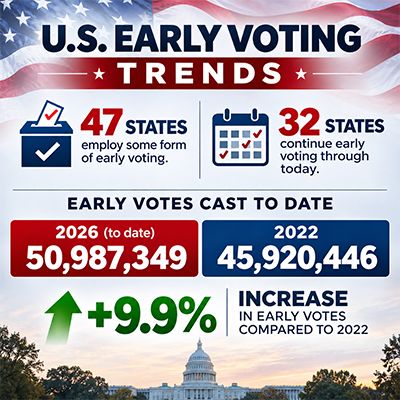
While 32 states continue early voting through today, with some accepting ballots until the polls close tomorrow, the process has concluded in 15 places. In those states, preliminary reports are now available.

To recap, 47 states employ some form of early voting. The three that continue to use the traditional Election Day model are Alabama, Mississippi, and New Hampshire.

Among the 15 states where early voting has ended, comparative reporting with the previous midterm election cycle (2022) is available in all but two. Missouri did not offer early voting in 2022, while Tennessee reported only in-person early voting totals four years ago and did not include mail ballots. Because the Volunteer State now reports both categories, comparisons with 2022 become inconsistent.

Nationally, according to the University of Florida’s Election Lab project, 50,987,349 individuals have cast early ballots. Although early voting remains underway in 32 states as of this writing, the current national total already exceeds the 45,920,446 early votes cast in 2022, representing a 9.9 percent increase. The trends are not uniform across the 13 places where valid comparisons are available, however. Five states, Florida, Nevada, Pennsylvania, Utah, and West Virginia, are reporting fewer early voters than they did four years ago.

Perhaps the biggest surprise in the early voting data comes from Louisiana, where participation has increased 42.4 percent compared to the 2022 midterm election. Other states posting significant gains include Maine (29.8 percent), Texas (28.9 percent), Maryland (23.1 percent), and Idaho (15.6 percent). Additional increases ranging from 11.8 percent to 3.1 percent are recorded in Georgia, Arizona, and Massachusetts.

In nine states, partisan turnout can be compared directly with 2022, and the results are mixed. The most consistent pattern is among non-affiliated, or Independent, voters. Their participation levels are higher in seven of the nine comparison states. Only in Idaho and West Virginia are non-affiliated voters underperforming their 2022 totals.

While most observers assume Democratic participation is rising significantly across the board, the early voting data do not consistently support such a conclusion. In the nine states where valid comparisons exist, Democratic early vote participation is up in six states, Florida, Idaho, Louisiana, Nevada, Utah, and West Virginia, but down in three, Arizona, Maryland, and Pennsylvania.

Republicans are exceeding their 2022 early voting participation levels in four states, Arizona, Idaho, Pennsylvania, and West Virginia, but trail their previous numbers in five others: Florida, Louisiana, Maryland, Massachusetts, and Texas. The two major parties have improved their early vote participation in Idaho and West Virginia, yet both are down in Maryland. Democrats and non-affiliated voters are together posting higher participation rates in Florida, Louisiana, Nevada, and Utah. Republicans and non-affiliated voters are together showing gains in only one state, Arizona.

The early vote numbers do not tell the full story regarding which candidates may be faring better, because election officials record only that individuals have voted, not how they voted.

Some clues can nevertheless be found in the data. Democrats may hold the edge many analysts are projecting in Texas when considering the state’s 28.9 percent increase in early voting compared to 2022. The strongest evidence comes from the fact that the largest proportional increases are occurring within the state’s major metropolitan areas. Texas reports only the total number of individuals who cast early ballots. Because the state does not register voters by party affiliation, partisan turnout figures are unavailable. Texas also does not release early voting data by demographic categories.

Democrats may also have a slight advantage in Nevada, where the party participation is up 1.5 percentage points compared with 2022 while Republican participation is down 4.3 percentage points.

Republicans, however, may be performing better than expected in Arizona. Democratic participation there trails the 2022 benchmark by three-tenths of a percentage point, while Republicans are exceeding their prior level by a full point.

The most significant shift may be occurring in Pennsylvania, where Democratic early vote participation is down 4.3 percentage points and Republican participation is up four points. Democrats still maintain an overwhelming advantage in ballots returned, 64.9 percent to 25.3 percent, but Republican candidates have remained competitive in statewide races even under previous early voting patterns.

Four of the states where early voting is complete provide demographic data by age. Nationally, preliminary participation numbers suggest a substantial increase in early voting among senior citizens, and three of the four states that can be analyzed, Georgia, Idaho, and Pennsylvania, see that trend. In Idaho, however, voters between the ages of 41 and 65 constitute the largest participating group.

This analysis provides only a snapshot of the 2026 early voting electorate. Meaningful conclusions will be possible only after the election is completed and the states release their official certified results.