Tag Archives: Redistricting

Updates on Louisiana, Maryland,
& Ohio Redistricting Plans

Maryland Congressional Districts

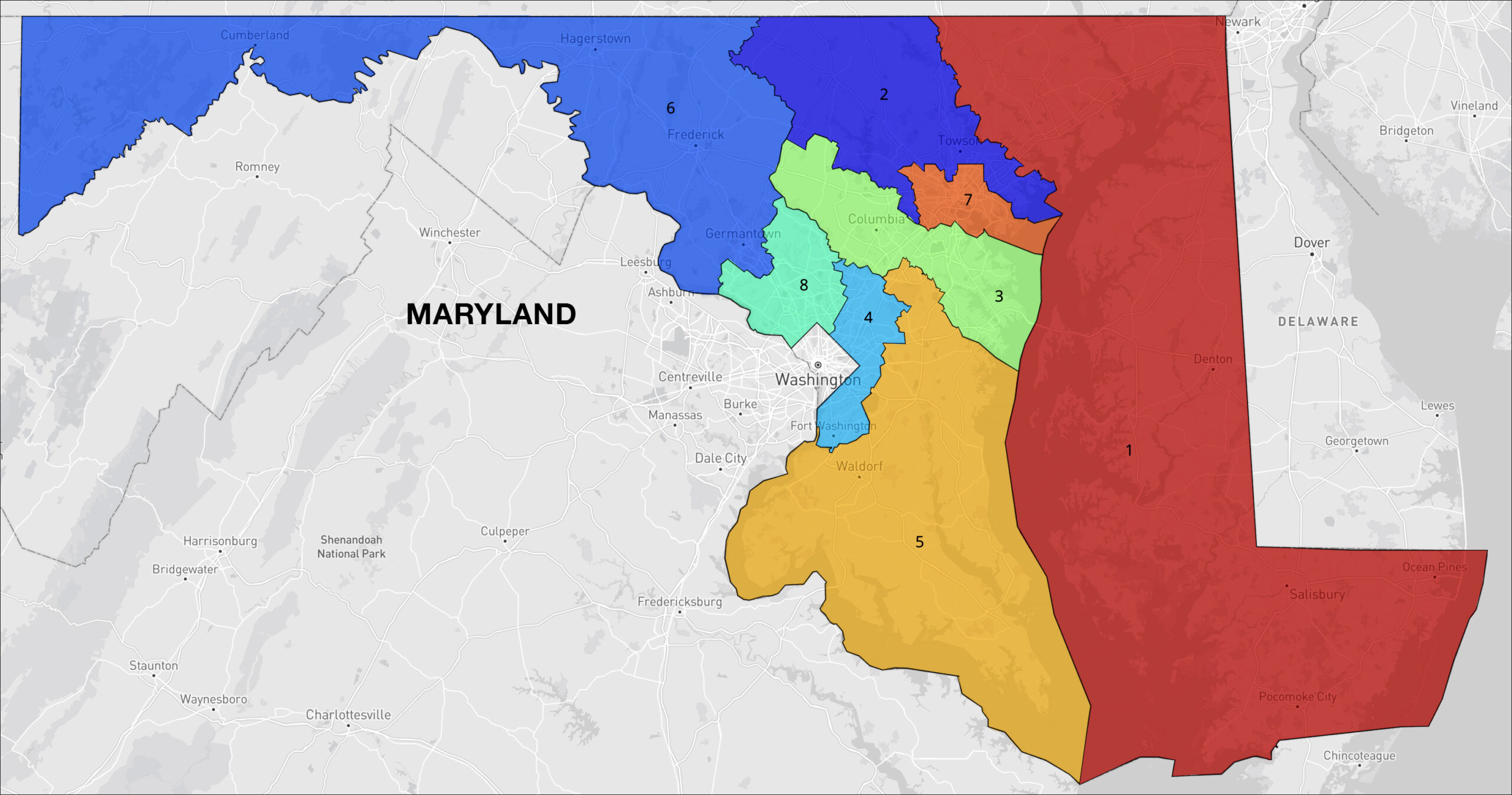
Maryland Congressional Districts (Click on map to see interactive version on DavesRedistricting.org.)

By Jim Ellis — Monday, Nov. 3, 2025

Redistricting

We saw redistricting moves occur in several states last week. Below is a recap of the action:

Louisiana

As the redistricting world awaits the US Supreme Court’s ruling on the Louisiana racial gerrymandering case, the Bayou State’s Governor and legislature passed legislation to move the state’s primary in anticipation of a ruling coming well after the first of next year.

Previously, the legislature and Gov. Jeff Landry (R) changed the Louisiana primary system to do away with their jungle primary held concurrently with the general election and an accompanying December runoff for those races where no candidate received majority support on the initial vote.

The new primary system returned to a partisan format scheduled for April 18, 2026, with a two-candidate runoff on May 30 for the races where no candidate received majority support.

The legislation passed earlier last week, now on its way to Gov. Landry for his signature, would move the initial primary date to May 16 with the associated runoff election on June 27.

Changing the primary will give the state more time to adjust their congressional map to adhere to whatever the Supreme Court eventually decides. The change also gives the candidates more time to campaign in the Senate primary where several contenders are mounting GOP nomination challenges against Sen. Bill Cassidy.

Maryland

It appears the Maryland legislature will not engage in another redistricting. According to a report from The Down Ballot political blog, state Senate President Bill Ferguson (D-Baltimore) sent a letter to his colleagues saying that the Senate leadership “is choosing not to move forward with mid-cycle congressional redistricting.”

Sen. Ferguson’s argument is that redrawing the current map “… could reopen the ability for someone to challenge” the present plan upon which the Democrats were able to routinely claim seven of the state’s eight congressional seats. Basically, the Senate President was explaining he was not going to risk a 7D-1R map for an uncertain attempt to add one more to the Democratic column.

Without the Senate’s participation, redistricting in Maryland will not occur. Thus, we see a break for the state’s lone Republican Congressman, Andy Harris (R-Cambridge), and the national Republican goal of maximizing their number of seats through mid-decade redistricting.

Ohio

The Buckeye State has both a complicated redistricting system and law. The process first starts with a commission of elected officials who authorize the drawing of maps, then votes upon and presents the approved plan to each house of the legislature. A map must receive three-fifths support in both houses to remain in place for the entire decade. Passing with a lesser amount means the plan can stand for only two elections. The Governor retains veto power over the completed legislative process.

Since the 2021 congressional plan failed to receive three-fifths support in both the state House of Representatives and Senate, it could only remain in place for the 2022 and 2024 elections. Therefore, Ohio must enact a new congressional plan before the 2026 election.

The bipartisan commission came to an agreement on a map last week, which will now be reported to the legislature. Understanding that the Republicans have strong majorities in both houses, but not three-fifths strength, the plan appears to give the GOP a chance to increase their delegation share by two seats.

The partisan percentage increase in both principal targets, however, appears to still make Democratic victories possible. The purpose of the compromise is to obtain enough bipartisan support to keep a new map intact for the decade’s remaining elections.

Statistics for the districts are not yet publicly available, but the new plan appears to make Districts 7, 9, and 13 slightly more Republican.

District 7 is already a Republican seat that two-term Congressman Max Miller (R-Rocky River) represents. The 9th is veteran Democratic Congresswoman Marcy Kaptur’s Toledo-anchored seat where her victory margin under the current boundaries fell to less than a percentage point in 2024. Finally, the politically marginal Akron anchored 13th CD is also made a bit redder. Rep. Emilia Sykes (D-Akron) has averaged just under 52 percent in two consecutive elections.

Both Reps. Kaptur and Sykes were going to be major 2026 Republican targets and this map will make them only slightly more vulnerable.

Republicans were also looking to target 1st District Congressman Greg Landsman (D-Cincinnati), but this map keeps the district in the marginal category and likely makes the Congressman at least a slight favorite for re-election.

Much more will be known when the map statistics and voting history under the new boundaries become publicly available. Until then, the swing margins remain points of conjecture.
Indiana Joins Redistricting Battle

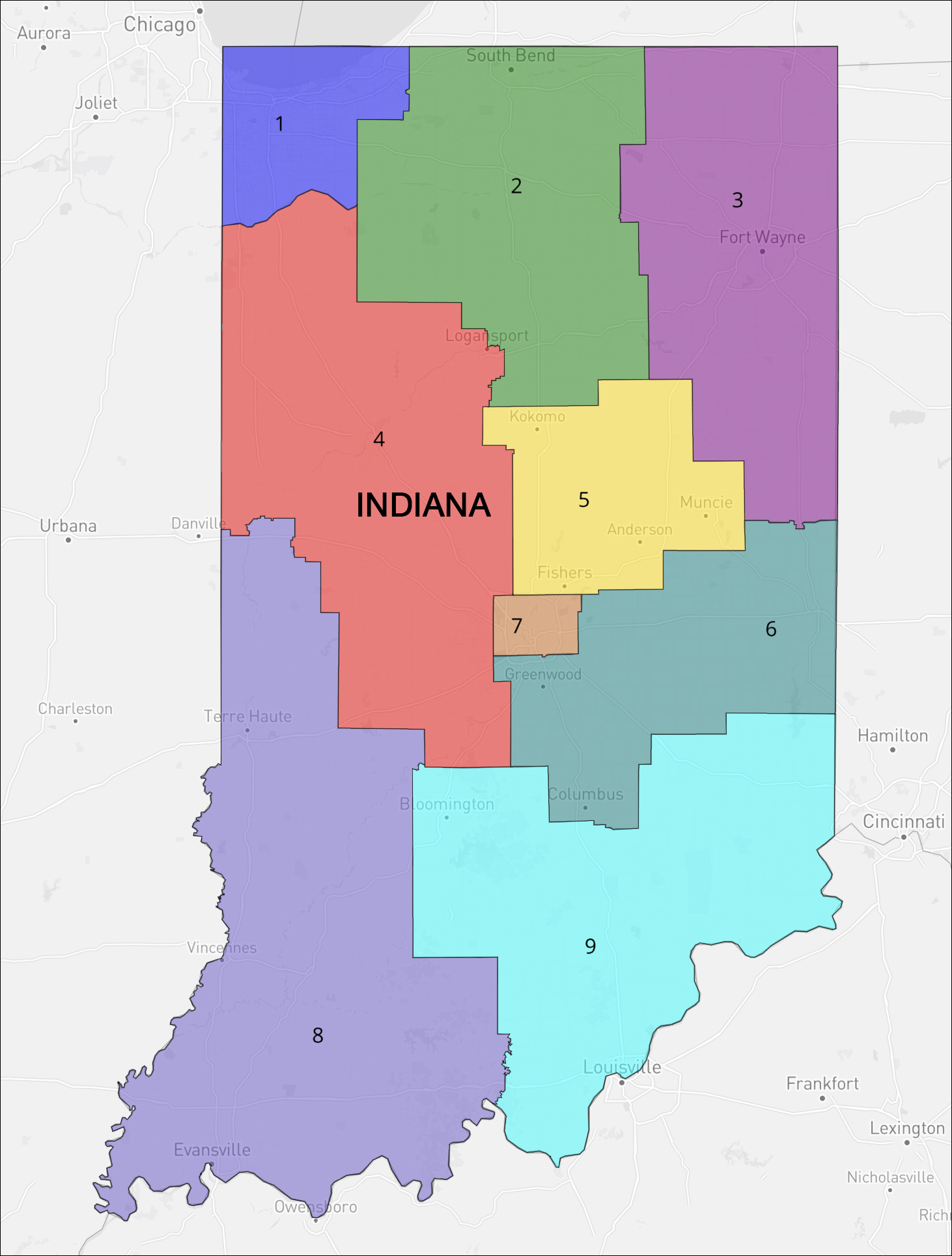
Current Indiana US House Congressional Districts map / Click on image to go to interactive version on Dave’s Redistricting App.

By Jim Ellis — Wednesday, Oct. 29, 2025

Redistricting

It appears we are seeing another state poised to join the mid-decade redistricting wars as an active participant.

Indiana Gov. Mike Braun (R) summoned the legislature back into session on Monday to work several issues and congressional redistricting is expected to be among them. It is now clear that Indiana will play a major role in how the new redistricting wave unfolds.

Developments favorable to Democrats in certain other states have now put selected Republican state leaders under further political pressure to attempt to neutralize those projected gains.

Indiana is one such place. Reports have been in the public domain for weeks saying that the White House, including Vice President J.D. Vance, who has met with Hoosier State legislative leaders on more than one occasion, have been overtly working to convince reluctant legislators to move forward. Gov. Braun has been supportive of the effort from the beginning.

Now, it appears we will see movement. The current Indiana congressional map features seven Republicans and two Democrats, but some believe the legislature could draw a 9R-0D map. Whether they go that far remains to be seen.

The Republicans’ obvious first target will be northwestern Indiana Congressman Frank Mrvan (D-Highland/Gary). His 1st District has become more competitive as evidenced by his lower than expected 53 percent average in his last two elections. Additionally, the Republican who ran strongly against Rep. Mrvan in 2022, retired US Air Force officer Jennifer-Ruth Green, is reportedly open to running again in a more favorable district.

The state’s other Democratic member is Rep. Andre Carson (D-Indianapolis), who has served nine full terms and part of another. Carson’s current 7th District is solidly Democratic (Dave’s Redistricting App partisan lean: 67.9D – 29.0R) meaning the new map would have to break his district into segments in order to create another Republican seat.

If the map-drawers pursue such a course, the pie-shaped format might be overlayed into the Indianapolis region. The pie-shape concept brings contiguous districts into a metro area sometimes for partisan reasons, though many point out that such a draw gives a particular metropolitan area more representation and thus the region has a stronger presence in Congress.

Should the Indiana legislators adopt such a strategy, Districts 4 (Rep. Jim Baird-R), 5 (Rep. Victoria Spartz-R), and 6 (Rep. Jefferson Shreve-R), would likely be fundamentally reconfigured. It is probable all of these districts would come into Marion County (only Rep. Shreve’s District 6 does now) to take a piece of Indianapolis city and non-city precincts, thereby stretching the 7th CD into more rural Republican areas.

Polling is now suggesting the California redistricting referendum will pass on Nov. 4 (latest released California survey: Emerson College — Yes 57, No 37). Therefore, Democrats could be in position to gain five Golden State seats according to the party’s projections.

Additionally, the Utah courts have ordered a redraw of that state’s congressional map because of a ruling saying the legislature, when constructing the current plan in 2021, ignored map construction criteria that voters approved in the previous decade. As a result, Democrats are likely to gain one seat from the Beehive State.

Therefore, Democrats will potentially gain six seats in California and Utah, and possibly one more if Maryland decides to redistrict.

There is also public discussion occurring indicating that Virginia could join the redraw fray if former Congresswoman Abigail Spanberger (D) wins the Governor’s race on Nov. 4. Even with a Democratic trifecta (Governor, state Senate, and state House of Delegates, which would occur with a Spanberger victory), redistricting would be no sure thing.

Virginia now has a hybrid redistricting commission composed of elected officials and citizens that have map drawing power. Therefore, the legislature will have to change the state’s redistricting structure in order to replace the current map. If they find a way, however, the Democrats could certainly make gains in the state since Republicans now hold five of Virginia’s 11 congressional districts.

Republicans would still come out ahead toward their goal of expanding the GOP Conference despite the aforementioned Democratic gains, however. It is probable that five seats would come from Texas, one on Missouri’s new map, one from North Carolina, all of which are complete, and further possible additions from Indiana as discussed, Florida, and Ohio (gaining two in each state). Louisiana and Alabama would likely follow suit if the Supreme Court eventually upholds the lower court ruling on the case currently before the justices.

North Carolina Redistricts

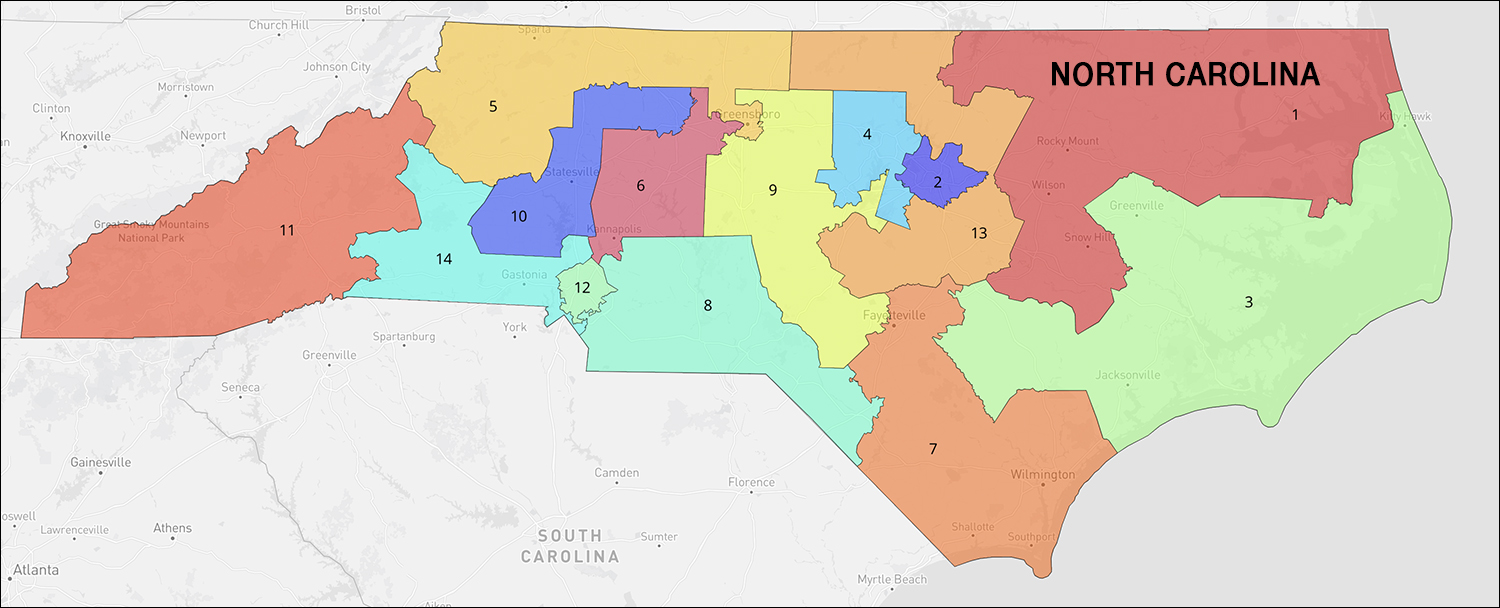
North Carolina redistricting map / Click on image to go to interactive version on Dave’s Redistricting App.

By Jim Ellis — Friday, Oct. 24, 2025

Redistricting

The Tar Heel State of North Carolina has joined the redistricting wars as members in both the state House of Representatives and state Senate voted this week to adopt a new congressional map.

Republican legislative leaders saying the need to protect President Trump’s agenda and counter what states like California are doing to help Democrats became the impetus for the North Carolina legislators’ action of revising their state’s federal district plan.

Since North Carolina law gives only the legislature the power to redistrict, Democratic Gov. Josh Stein had no role in the process. Therefore, upon passing each chamber –the House followed the Senate’s lead and voted favorably yesterday – the new map became law.

The 2025 congressional plan shifts 10 counties between Reps. Don Davis’ (D-Snow Hill) 1st District and Greg Murphy’s (R-Greenville) 3rd CD. The shift makes the 1st District — which President Trump carried in 2024 before the electorate switched back to Rep. Davis — more Republican while the overwhelmingly Republican 3rd District becomes more Democratic.

The Republicans’ political mark is clearly Rep. Davis. In November, the incumbent was re-elected with only a slim 49.5 – 47.8 percent margin over Republican nominee Laurie Buckhout. With such a small Democratic congressional win in a district that President Trump carried, and bordering a solidly Republican district to the south, made the 1st District an easy GOP target.

The 1st CD begins at the Virginia border and covers most of northeast North Carolina. To make it more Republican, the map drawers drove the district further south along the coast to annex additional GOP counties. This forced Rep. Murphy’s 3rd CD to move west and further inland. The remaining dozen Tar Heel congressional districts remain untouched.

The changing counties transform the 1st from one where President Trump defeated Kamala Harris 51-48 percent, into a seat where the electorate would have posted a 55-44 percent Republican margin. Conversely, the Trump percentage in District 3 would recede from 57.9 to 53.5. While Rep. Murphy’s district clearly becomes more competitive, he will still have enough of a partisan margin to win comfortably in a region that is likely to grow more Republican as the decade progresses.

Rep. Davis took to social media, according to the Down Ballot political blog reporters, to indicate that he would seriously consider remaining in the District 1 race even though his hometown of Snow Hill in Greene County would move to CD-3.

The Congressman said, “as we look at new congressional districts, I am considering every option, drawing on my local roots, experience in the military, and commitment to education,” in deciding what political move to make. Davis’ problem is there are no other available offices for which he can compete in 2026.

Though North Carolina has a dozen statewide offices, only one, Sen. Thom Tillis’ (R) open seat, is on the ballot next year. Since Democratic former Gov. Roy Cooper is already in that race and a consensus candidate, Davis has virtually no other political option than to run for the US House in a more difficult district.

With Buckhout accepting a job in Washington with the Trump Administration, she will not return for a 2026 rematch. In the race are Rocky Mount Mayor and former congressional candidate Sandy Roberson and state Sen. Bobby Hanig (R-Currituck).

Lenoir County Commissioner Eric Rouse (R) recently announced his congressional candidacy, but Lenoir County moves to the 3rd District under the new redistricting plan. It is unclear whether Rouse will continue now that his home political base is no longer in the 1st District.

Redistricting is nothing new in North Carolina. In the previous decade, the maps kept changing almost every election cycle. The reason was the dispute between the Republican legislature and the Democratic state Supreme Court. The preponderance of members in each body held different redistricting legal opinions. When the Republicans captured the court majority in the 2022 election, a unified redistricting approach was adopted.

We can expect lawsuits to be filed over the new map, but the chances of overturning the plan clearly drawn for partisan and not racial reasons means the 2025 version will very likely be the footprint upon which the candidates will run next year.

US Supreme Court Hears
Louisiana Redistricting Case

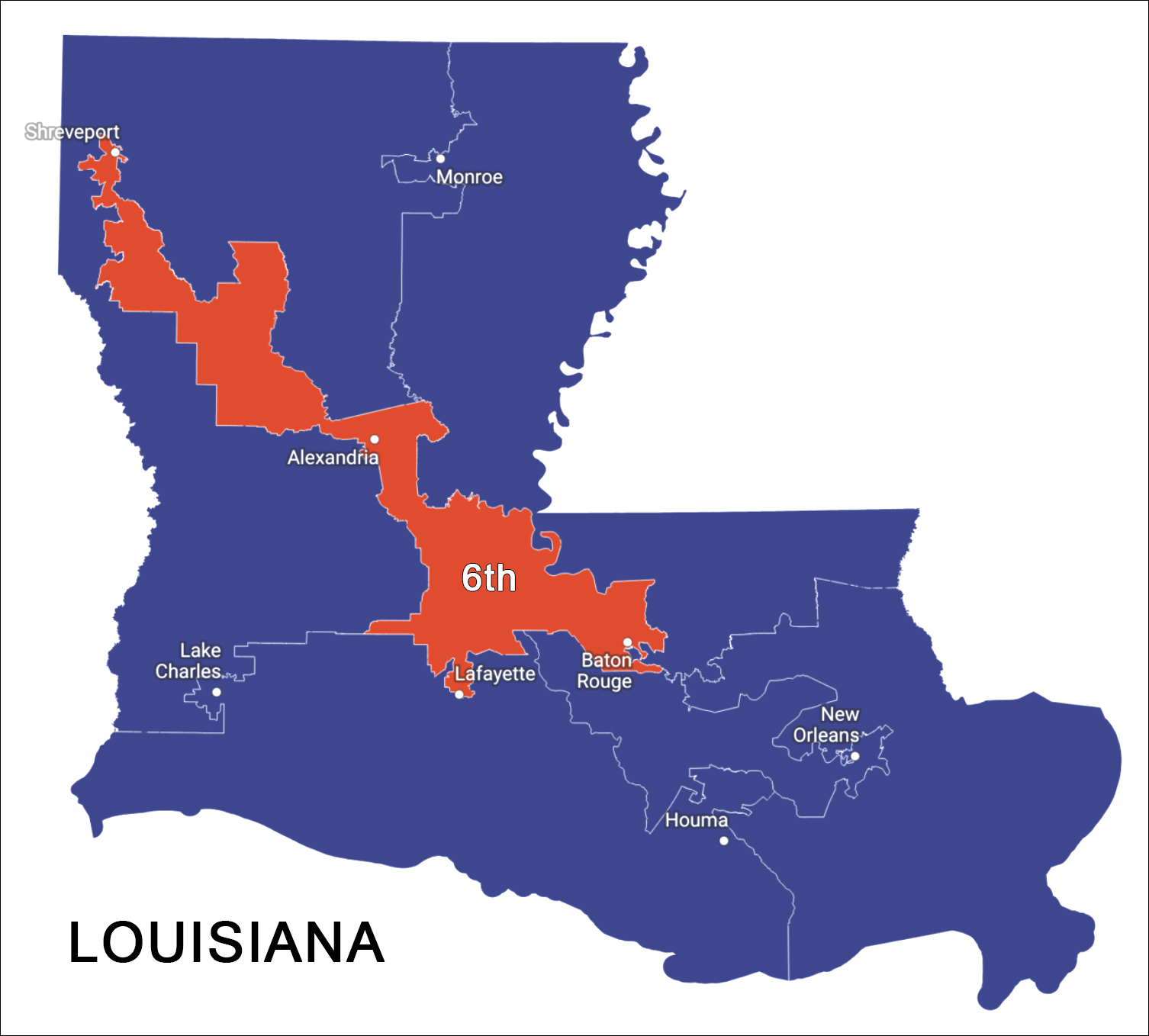
Louisiana’s 6th Congressional District / Graphic by VeriteNews.org

By Jim Ellis — Thursday, Oct. 16, 2025

Redistricting

Yesterday, the nine United States Supreme Court justices heard oral arguments for the second time on the Louisiana racial gerrymandering case. How this case is decided could have a major impact on the 2026 US House election cycle and in district elections throughout the remainder of the current decade.

At issue is Louisiana’s 6th Congressional District (in red on above map), which stretches from Baton Rouge to Shreveport. This CD was put in place before the 2024 election in response to a court order to create a second majority minority district that would elect an African-American Representative. Ironically, this very draw was rejected in a 1994 ruling, but the 2024 map drawers reinstated the same district 30 years later.

A lawsuit was filed over the redraw and the plaintiffs earned a favorable decision from the initial three-judge federal panel constructed to hear the case, but the US Supreme Court stayed the ruling. After briefs and oral arguments were conducted, the high court chose not to rule in June opting for a second round of oral arguments, which were held yesterday.

According to news stories and observations, impressions suggest that several justices appear favorable toward changing the particulars that heretofore have governed the parameters relating to minority district construction. Whether a majority exists to do so and to what extent change may be forthcoming remains unanswered.

The eventual decision could have wide-ranging ramifications to maps in several other states, and not just those where legislators are currently either drawing new districts or contemplating such action.

A SCOTUS decision to uphold the three-judge panel ruling would allow the Louisiana legislature to return to the previous map, or a similar one. That particular map produced a 5R-1D partisan division. The current Louisiana congressional delegation consists of a 4R-2D split.

If the three-judge panel ruling is upheld or expanded upon, the Alabama map would be affected because that state is in virtually the same situation as Louisiana with regard to minority district composition. Such a decision would also virtually eliminate any serious challenge to the new Texas map.

Therefore, with the updated Lone Star State map projected to net Republicans five seats — and should the previously described scenario in Louisiana and Alabama come to fruition and before the 2026 election — the Republicans could net seven seats from the three states. Even if the California redistricting referendum passes and the Democrats net five seats to neutralize the GOP’s Texas gains, the net Republican increase from the four domains would be two. Adding the new completed Missouri map, and the Republicans would see a net three-seat national gain.

Other states in some way, shape, or form considering redistricting either with a special legislative session or when their next regular session begins, or through a court directive are Florida, Georgia, Indiana, Kansas, Nebraska, North Carolina, and Ohio. These could favor Republicans. While Illinois, Maryland, and Utah would likely produce Democratic gains.

Not all of these states will move forward, but should the Supreme Court ruling on the Louisiana case be of a landmark proportion, some of these states and others may then be compelled to follow suit.

Another factor is when SCOTUS rules. Louisiana now has an April partisan primary schedule, so one would think the ruling will be revealed in time for the nomination elections to be conducted as scheduled. A later ruling would suggest that a great deal of the redistricting action will greatly affect the 2028 House election schedule instead of 2026.

We can expect many future political twists and turns in the pending redistricting war, but the catalyst to developing clear district construction criteria lies with the US Supreme Court.

North Carolina Redistricting

North Carolina redistricting map / Click on image to go to interactive version on Dave’s Redistricting App.

By Jim Ellis — Tuesday, Oct. 7, 2025

Redistricting

The Tar Heel State of North Carolina appears positioned to join the national redistricting wars. The state has been redrawn more than any other since the 2010 census, and it looks like the legislature may again change the congressional district boundaries.

North Carolina has a unique system where the Governor has no veto power over redistricting. Republicans have solid control of both legislative houses, which is all they need to change the map. Before the 2022 election, the legislature and state courts were in a perennial battle over redistricting as it related to the race issue. The Republican legislature would pass a map and the state Supreme Court, with a Democratic majority, would reject it and impose a different draw.

In the 2022 election, the Republicans captured the state Supreme Court majority, thus uniting the legislature and judiciary with regard to redistricting legislation. This led to the General Assembly replacing the court imposed map that yielded each party seven seats and, with judicial approval, enacted the current draw where Republicans control 10 seats and Democrats four.

Turning to the national redistricting wars where many states are redrawing or considering replacing their congressional map, the North Carolina legislative Republicans may make a further adjustment. Doing so would net another GOP seat, thus creating an 11R-3D statewide congressional map.

The target will be the state’s politically marginal eastern 1st District that two-term US Rep. Don Davis (D-Snow Hill) represents. The 1st is one of 13 districts nationally that President Trump carried but the electorate then turned and elected a Democrat to the US House. In NC-1, Trump scored a 51.2 – 48.1 percent victory margin over Kamala Harris. In the same 2024 election, Rep. Davis defeated Republican Laurie Buckhout, 49.5 – 48.7 percent.

North Carolina’s 1st District covers 21 counties and part of one other. The seat hugs the Virginia border from just west of the cities of Rocky Mount and Wilson along Interstate 95 and then moves east all the way to the Atlantic Ocean. It then stretches south and east of Raleigh to achieve population equivalency with the other districts. According to the Dave’s Redistricting App statisticians, the partisan lean here is a fairly tight 50.9D – 47.7R.

Looking at the map from a partisan perspective, which the legislative leaders and the White House certainly are, it would be relatively easy to make the 1st District more Republican, thus making it easier to defeat Rep. Davis.

The 1st shares a border with Rep. Greg Murphy’s (R-Greenville) 3rd District. An interchange of an equal number of Democratic and Republican voters from District 1 to District 3 would endanger Rep. Davis and still create a safe Republican seat for Rep. Murphy while not disrupting the other nine Republican members’ districts. The Dave’s Redistricting App partisan lean for the current CD-3 is 57.2R – 40.7D.

Leaders in many states are discussing redistricting for their next legislative session. The Texas and Missouri maps are complete and will face the perfunctory legal challenges. California Democrats are countering the Texas map with a referendum designed to replace the California Independent Redistricting Commission’ plan enacted in 2021. Polling suggests a close vote for Proposition 50 in the Nov. 4 special statewide election, but the overwhelming Democratic registration numbers and their resource advantage suggest that they can probably win the election.

Both the Texas and California map are drawn with the intent of adding five seats to their party’s congressional delegation, Republicans in Texas and Democrats in California. If the maps perform as designed, the respective five-seat gains will cancel one another. Hence, the importance of other states redrawing their maps for Republicans to strengthen their current US House majority.

If North Carolina redraws, their new Republican seat and the one in Missouri will net the GOP an additional two seats in the House.

The Florida legislature is already planning to redistrict upon their return to regular session in January. Their plan could net the GOP a reported two seats. Indiana Republican legislative leaders, with encouragement from the White House, are potentially considering a redraw that also could net the GOP two seats. Under state law, Ohio must redraw because the current map did not receive three-fifths support in the legislature. The new map could net the GOP a further two seats.

The Utah courts have ruled that their state’s congressional map is illegal because the legislature ignored redistricting criteria that voters adopted in a previous election. A new draw could give the Democrats a net gain of one.

Perhaps the most defining redistricting issue is the Louisiana racial gerrymandering case currently before the US Supreme Court. The justices didn’t rule in June as expected, instead scheduling a new round of oral arguments for Oct. 15. The eventual Louisiana ruling could affect the redistricting situation in several other states and could prove to be the landmark racial gerrymandering ruling that will finally clarify what the states can and can’t do to remain in compliance with the US Constitution and the Voting Rights Act of 1965.

The final redistricting decisions and moves will have a profound impact upon the 2026 US House election cycle. Whichever party ultimately prevails in the better position will have a major advantage toward securing a House majority for the 120th Congress.

Utah Joins Redistricting Wars

By Jim Ellis — Friday, Aug. 29, 2025

Redistricting

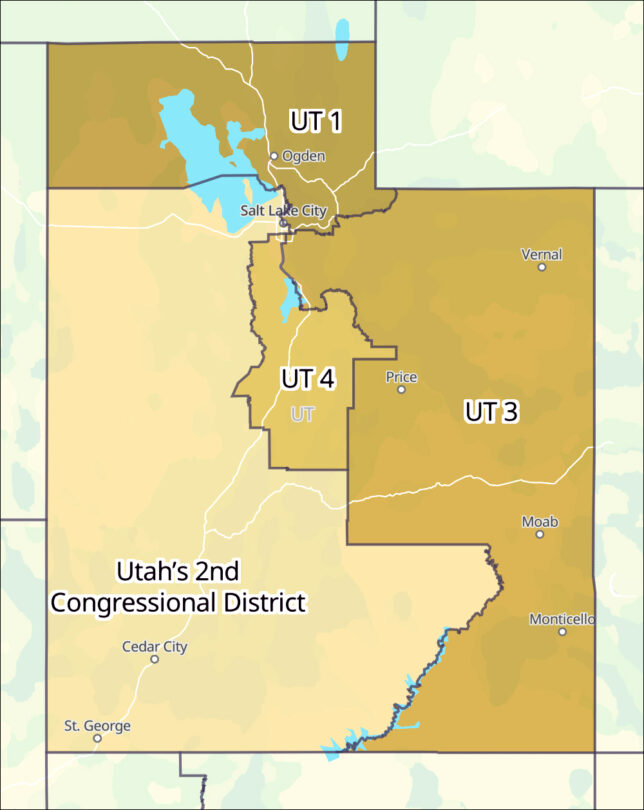
Utah Congressional Districts (click on image to go to interactive map)

A new court decision has thrust another state to the forefront of the mid-decade redistricting battle that may be developing in as many as 11 states.

A Utah judge early this week issued a ruling that strikes down the state’s 4R-0D congressional map, saying the legislature did not have the right to usurp the citizens’ redistricting commission that voters approved via ballot proposition in 2018. The commission members crafted a congressional map in 2021 that the state legislature rejected and replaced with the current plan.

The ruling is curious in that the judge stated the Utah Constitution makes a vote of the people equal to that of a legislative action. Therefore, District Court Judge Dianna Gibson ruled that the legislature did not have the authority to change the Commission map but did not explain why the people’s vote then trumps legislative power if both are equal. Republicans will appeal to the State Supreme Court, though the high court previously allowed the original lawsuit to continue that resulted in Judge Gibson’s ruling.

The Commission map would likely cost the Republicans one seat since it created a Salt Lake City-anchored district that would presumably elect a Democrat. Like many redistricting battles, this one, too, has the potential of making its way to the US Supreme Court for a final decision.

Currently before the federal high court remains the Louisiana racial redistricting case. A ruling was expected before the end of June, but the justices instead postponed their decision and ordered additional oral arguments, now scheduled for Oct. 15. The court’s ultimate ruling could mean a Louisiana redraw before the 2026 election. If so, Alabama could also see a redraw since their redistricting situation is virtually identical to that of Louisiana.

The just-enacted Texas map already faces a racial gerrymandering lawsuit, this in an El Paso federal court. The Louisiana ruling could affect the new Texas map since the lawsuit grounds involve an alleged violation of the Voting Rights Act.

When the Ohio legislature returns to session in September after the summer break, a new congressional map will be drawn. Since the current plan, adopted in 2021, failed to pass the legislature with at least a three-fifths vote in each chamber, the map could only stand for two elections. Therefore, state law demands a new plan be crafted for the 2026 election and beyond.

Published reports indicate that redistricting is also being considered in Florida, Indiana, Maryland, Missouri, and New York. The referendum in California to usurp the citizens’ commission map and replace it with a published alternative will go to the voters in a Nov. 4 special election.

The Florida House Speaker has assembled a new redistricting committee, and Gov. Ron DeSantis indicates he favors attempting to draw a new map. Some believe the already strong Republican Florida map could yield two more seats.

Talks are underway in Indiana about undertaking redistricting. The GOP target here would be the state’s 1st District that Rep. Frank Mrvan (D-Highland/Gary) represents. In the past two elections, the Congressman recorded a pair of 53 percent victories.

Talk surfaced in Maryland, largely stemming from Gov. Wes Moore (D), that this state could attempt to eliminate the lone Republican district, but nothing concrete toward that end has yet happened.

Republicans are also making progress toward gaining the Kansas City-area district of Rep. Emanuel Cleaver (D); moving forward in this situation appears likely.

Finally, New York Gov. Kathy Hochul (D) also made public statements about redistricting retribution. Here too, however, a citizens’ commission is involved in the process. In 2021, even a Democratic court rejected the Democratic legislature’s map after the members found a way to usurp the commission plan. In the legislature’s map, the Republicans would have been relegated to four of 26 seats, which the court rejected.

While the Democrats could gain further seats in New York, the process of changing the current map may be too complicated to do so before the 2026 election.

As one can see, redistricting is a complex issue, and predicting what may happen next in any state’s process is always a difficult proposition.

Redistricting:
New Texas Map Unveiled

Newly proposed Texas redistricting map
(Click here to see current CD interactive version: Texas)

By Jim Ellis — Friday, Aug. 1, 2025

Redistricting

The new Texas proposed congressional map was unveiled Wednesday and, as President Trump predicted, the new draw could produce a net of at least four and possibly five more Republican seats in the 38-member delegation.

The redistricting process started, and Gov. Greg Abbott (R) added the issue to his special legislative session agenda, because the US Justice Department informed the Governor and Secretary of State that several of the state’s congressional districts are now illegal due to a recent en banc ruling from the 5th Circuit Court of Appeals on a Galveston County redistricting lawsuit.

The ruling paved the way for the state Republican map drawers to create more favorable political districts.

The legislative battleground will be in the state House of Representatives. There, the Republicans have an 88-62 majority, but Speaker Dustin Burrows (R-Lubbock) was elected via coalition as Democrats crossed over to support him. The action sent the Republican Caucus candidate down to defeat. The state Senate is even more Republican, 19R-11D, with one GOP vacancy.

Internal Texas legislative politics pertaining to partisanship, committee chairmanships, and the Speakership itself could all turn based upon how this redistricting issue unfolds over the next few days. The special legislative session began on July 21 and can last no longer than 30 days. The Governor, however, can call additional 30-day sessions if the issue call is not completed.

Several times in the past 20 years, Democratic members have left the state in order to break the chamber quorum and thus prevent legislative business from progressing. Texas is perhaps the only state where the legislature holds a two-thirds quorum requirement, so Democrats have enough to prevent the House from convening should at least 50 of their members not appear.

US House Minority Leader Hakeem Jeffries (D-NY) is coming to Texas to speak to the House Democratic Caucus and convince them to do what is within their power to prevent the map, and its likely Republican seat gain, from being enacted into law.

To further complicate matters, the state has the power to arrest lawmakers who refuse to attend session and force them into the chamber, so the next few days will become interesting.

While the Democrats could temporarily freeze the House, their power is limited. Gov. Abbott could simply end the session and then call the members into a new 30-day special conclave if not enough members are present. He can stop and start special sessions at will. Additionally, at least five other issues, including flood relief for Central Texas, are also on the issue call, meaning more than redistricting must be addressed.

If the presented redistricting plan is enacted, several Democratic members will face tough political situations.

Beginning in Harris County, the map would create a new open eastern Houston area district that would be heavily Hispanic but favor Republicans based upon recent voter history. This would lead to Rep. Al Green (D-Houston) being paired with the winner of the TX-18 special election in a new Harris/Ft. Bend County 18th CD.

Moving to the Dallas area, freshman Rep. Julie Johnson (D-Farmers Branch) would find her district moved to east Texas, thereby likely forcing her into a paired incumbent situation with Rep. Marc Veasey (D-Ft. Worth). Veasey could also choose to run against Rep. Jasmine Crockett (D-Dallas). Her new 30th District would venture into Tarrant County, which is part of Veasey’s home base.

In the Rio Grande Valley, Rep. Vicente Gonzalez (D-McAllen), saw his 88 percent Hispanic Voting Age Population seat vote for President Trump (52-47 percent). Therefore, Gonzalez’s 34th District becomes 11 percentage points more Republican by moving out of Hidalgo County and then northward to Nueces County, annexing a portion of Corpus Christi city.

In Austin, Reps. Lloyd Doggett (D-Austin) and Greg Casar (D-Austin) would find themselves paired in a new 37th District that would be fully contained within Travis County. The result of this draw would create a new open 35th District anchored in east San Antonio that appears politically marginal but is more likely to land in the Democratic column.

The removal of the Bexar County (San Antonio) portion from Rep. Henry Cuellar’s (D-Laredo) 28th District is likely welcome news for the veteran Congressman who is widely cast as the House’s most conservative Democratic member. Cuellar had not performed well in the San Antonio area, so this new map likely strengthens him.

More will be known about the districts when further data is calculated and released, but the current available statistics find just two districts, TX-19 (Rep. Jodey Arrington, R-Lubbock) and TX-23 (Rep. Tony Gonzales, R-San Antonio), untouched. Two districts (TX-9 and TX-35) would be new. Of the remaining 34 CDs, 19 would become more Republican to varying degrees and 15 would become more Democratic, again to varying degrees.

While this map would greatly help the Republicans hold the US House majority in the 2026 elections, it is not certain that such a plan will ultimately be enacted.