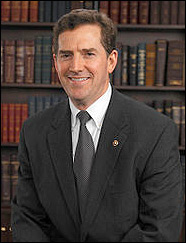
Author Archives: Jim Ellis

Haley Narrows Her List

South Carolina Gov. Nikki Haley’s (R) visit to the Charleston area yesterday did not result in her naming a replacement for outgoing Sen. Jim DeMint (R) as some thought it might, but reports from her office suggest that her short list contains five names.

Top Choice: Rep. Tim Scott

Most believe the leading contender is freshman Rep. Tim Scott (R-SC-1), who won a big re-election in November and was subsequently appointed to the House Ways & Means Committee. Aside from being a capable replacement for DeMint, Rep. Scott scores political points for the governor in several ways. Haley is standing for re-election in 2014 with upside down approval ratings, and along comes a new Public Policy Polling survey (Dec. 7-9; 520 registered South Carolina voters) that posts her two points behind (44-46 percent) the man she defeated in 2010, Democratic state Sen. Vincent Shaheen. This tells us that the governor needs political strengthening.

Among other benefits, the Scott appointment would allow her to take credit for appointing the first African-American senator in the state’s post-Reconstruction history. Secondly, since Scott enjoys strong support from South Carolina’s Tea Party movement, selecting him would help Haley with the very group that could bring forth a challenger against her in the Republican primary. Third, by appointing the Charleston area congressman, she can restore the Upcountry/Low Country balance that the state traditionally featured. Both current senators, DeMint and Lindsey Graham (R), are from the northwestern sector of the state. Thus, she could theoretically increase her Charleston area support with this move. Fourth, Haley would gain kudos from national conservatives who are also pushing Scott for the appointment, possibly including Sen. DeMint himself. Though he claims not to be lobbying for anyone, most observers believe that the outgoing incumbent favors Rep. Scott as his successor.

The Remaining Four Options

Others on what is believed to be her short list of contenders are Rep. Trey Gowdy (R-SC-4), state cabinet officer Catherine Templeton, former Attorney General Henry McMaster (R), and Jenny Sanford, the state’s former First Lady, who handled herself so positively during her husband’s — former Gov. Mark Sanford — nationally publicized extra-marital affair.

Rep. Gowdy, also a freshman who just won a big re-election, brings little to the table for Haley. Though conservative, he represents DeMint’s former congressional district, so he fails to bring any geographic balance. He is unknown outside of the Greenville-Spartanburg region, so it’s difficult to see how the governor improves her own standing through his appointment.

Templeton is a confidant of the governor who already has received appointments to a pair of statewide cabinet posts. She currently is in charge of the South Carolina Department of Health. She hails from the Charleston area, thus bringing geographical balance but has little in the way of a political base. Furthermore, Templeton has no legislative experience, so starting her career as a legislator in the United States Senate will require a rather large learning curve that could put her well behind in preparing for a statewide election. This could make her vulnerable in what would likely transform itself into a messy primary confrontation — something Haley will certainly want to avoid.

McMaster is a former two-term attorney general and chairman of the South Carolina Republican Party. He ran against Sen. Ernest “Fritz” Hollings (D-SC) in 1986, and for governor against Haley, herself, in 2010. McMaster finished a distant third in the gubernatorial primary contest, failing to secure the second run-off position. That fell to Rep. Gresham Barrett (R-SC-3), who Haley defeated in a landslide. McMaster, from Columbia, does not appear to be a good fit for Haley, but including him on her short list does throw a bone to the state’s Republican establishment.

Jenny Sanford is a popular figure with obviously high name identification. She, too, is from Charleston and highly identified with the city, since she maintained the family home there instead of moving to the Governor’s Mansion in Columbia when her husband was elected. Sanford is not closing the door on accepting the appointment, saying she is “honored” to be considered. What is probably more likely than her being appointed to the Senate is running in the special election for the 1st Congressional District – her husband’s former House seat – should Scott receive the appointment.

The Likely Outcome

The prevailing political winds point toward Gov. Haley appointing Rep. Scott. Expect this action to occur immediately upon Sen. DeMint’s official resignation. All of the prospective candidates on this list would be competent Senators for the state, so making a credible selection is not an issue. Since Scott is the best political pick, and the governor needs a political boost, the odds are strong that she will soon turn in his direction.

Crist Makes It Official

charlie-crist

Former Florida Gov. Charlie Crist officially registered as a Democrat yesterday in what is likely a prelude to entering the 2014 gubernatorial contest against incumbent Rick Scott (R). Crist announced the move via his Twitter account, Tweeting a picture Friday of he and his beaming wife with his Florida voter registration form. Crist, as a Republican, served one term as governor and chose to run for Senate instead of seeking re-election. The move proved politically disastrous.

Marco Rubio, then a former state House Speaker, ran such an effective early Republican primary campaign that Crist was literally forced out of the party, choosing to run in the general election as an Independent. He placed second to Rubio, trailing 49-30 percent, but came in 10 points ahead of the Democratic nominee, then-Rep. Kendrick Meek (D-FL-17).

Usually, a party-switcher’s most difficult election is his first primary in the new party. If Crist enters the Democratic nomination contest, he almost assuredly will have competition. In fact, he could still face the Democratic 2010 gubernatorial nominee, former Florida Chief Financial Officer Alex Sink, who only lost to Scott by a scant one percentage point, 49-48 percent. Sink has yet to rule out another run.

Scott is viewed as vulnerable because his job approval ratings have continued to hover around the 40 percent mark or lower for most of his tenure. As is the case for virtually every race in Florida, the contest is expected to be close.

Canseco Mulling Comeback in Texas

Rep. Quico Canseco (R-TX-23), who lost 46-50 percent to Democratic state Rep. Pete Gallego in November, says he is considering making a comeback in 2014. The 23rd District is a marginal seat that has flipped between the two parties since 2004. The district stretches from San Antonio all the way to El Paso.

The 23rd is likely to be one of the 2013 redistricting focal points that must be addressed. Because the courts have not approved a permanent Texas map, work either in the state legislature or the jurisdictional judicial panel must occur next year. Now that the seat has a Democratic incumbent, expect more members of this party to be added. It is likely that, at the end of the new redistricting process, Representative-elect Gallego will have a more favorable district from which to seek re-election, particularly if the San Antonio three-judge panel finds itself drawing the new map.

Haley Calls Charleston News Conference

Gov. Nikki Haley

Gov. Nikki Haley

South Carolina Gov. Nikki Haley (R) has scheduled a news conference in Charleston today, leading to speculation that she could tab Charleston Congressman Tim Scott (R-SC-1) as outgoing Sen. Jim DeMint’s replacement. Haley has not indicated who she will appoint, or even if she will address the Senatorial vacancy in her news availability, but she did issue a statement that appears to reject the notion of choosing a caretaker for the position.

Rep. Scott would become the first African-American to represent South Carolina since Reconstruction. He was first elected to the House in 2010, and enjoys strong support from the conservative wing of the party. Such being the case, it is probable that he would have little trouble in claiming the party nomination for the 2014 special election in order to serve the remainder of DeMint’s term. Since the seat is regularly in-cycle in 2016, the special election winner will have to run again in just two years.

Should Scott gain the appointment and solidify himself early for election, then conservative attention could return to finding a primary challenger for Sen. Lindsey Graham (R), who will also be on the ballot in 2014. Rep. Scott was just appointed to the House Ways & Means Committee, meaning that this vacancy would likely be filled before the end of January. Should Scott or any other member of the Congressional delegation be chosen, a special election would be called in early 2013 to determine a replacement.

Boustany Wins in La., and Why

Just as Republican state legislative leaders had designed when using their redistricting mapping software early in the year, Rep. Charles Boustany (R-LA-7) easily defeated freshman Rep. Jeff Landry (R-LA-3) in the new 3rd Congressional District, winning a 61-39 percent victory on Saturday.

The Map

Louisiana dropped a Congressional seat in national reapportionment, and even though the Republicans controlled the redistricting pen, it was obvious that their own party would lose a seat. As is typical of these situations, it was the freshman member who was put in the expendable position.

Prior to reapportionment, Louisiana had seven Congressional seats, six Republican and one Democratic. Since the New Orleans-anchored 2nd CD is a Voting Rights Act protected district, the Republicans had no other choice but to forfeit a seat. Thus, Rep. Landry’s southern state district that legislative leader Billy Tauzin, the former Energy & Commerce Committee chairman, once held was broken into pieces. Even though 7th District incumbent Boustany was placed in the pairing with Landry, the contest was never intended to be fair.

Boustany’s 7th District territory comprised 76 percent of the new 3rd CD, and included the congressman’s home and political base of Lafayette Parish. Landry’s New Iberia Parish domain was also transferred to the new 3rd, but the final configuration only contained 24 percent of his constituency. In the end, the district performed as intended. Each candidate racked up landslide proportions in their current regions, but Landry, having so little familiar turf, could not overcome the programmed disadvantage.

The Results

Boustany carried seven of the district’s 10 parishes, including Lafayette (71 percent), in the range of 68-75 percent. Landry took the three parishes from his former district, also in a similar percentage spread, winning New Iberia with a 70-30 percent margin and the other two parishes with 65 and 67 percent of the vote.

Louisiana also has a unique election system. Using their traditional “jungle” primary format where all candidates appear on the same ballot irrespective of political party affiliation, the state chooses to schedule their qualifying contest concurrently with the national general election. That way a majority of the vote elects the candidate obtaining such, and a run-off between the top two finishers scheduled for early December is held if no one tops 50 percent. Nationally, this makes at least some of Louisiana’s federal races the last to be decided.

Though Boustany finished first on Nov. 6th, his 44 percent total was well short of a majority, hence Saturday’s run-off. Only 19.3 percent of the district’s 500,592 registered voters participated in the run-off election, meaning 96,584 total votes were cast. Of that number, 16,835 people took advantage of the early voting option, meaning 82.6 percent of voters went to the polls this weekend.

The Future

Considering Louisiana’s tradition of not defeating incumbents of either party, Boustany can count on representing this seat at least until the end of the current decade. But, we may not have seen the last of Landry, either. Speculation was beginning to surface that, if he lost this run-off battle, we would see him enter next year’s Senate race against three-term incumbent Mary Landrieu (D). It is widely believed that Rep. Bill Cassidy (R-LA-6) is planning a Senatorial campaign, but this may not matter in the least to the now-defeated Landry.

DeMint Moves to Heritage; Who’s Next?

Sen. Jim DeMint

Sen. Jim DeMint

The unexpected announcement that Sen. Jim DeMint (R-SC) will resign his seat in January to become president of the Heritage Foundation yields two major surprises. First, is the timing of his departure. Though Mr. DeMint had pledged to only serve two senatorial terms upon his original election, he still has four years remaining in his allotted tenure. Second, the big winner lurking behind the scenes in this unfolding scenario could be South Carolina’s senior senator, Lindsey Graham.

DeMint has been a key conservative leader since his original election to the state’s 4th Congressional District in 1998. That year he pledged to serve only three terms in Washington. During DeMint’s final year in the House, Sen. Ernest “Fritz” Hollings announced that he would not seek re-election, thus providing the outgoing congressman an opportunity to seek an open Senate seat in 2004.

With the Senate moving further left after the 2012 election results, the opportunity of helping to craft and rebuild the conservative movement outside Congress by running one of the premier right-of-center think tanks proved more alluring to DeMint that toiling in an even smaller minority.

Sen. Graham factors into this scenario differently. Facing the voters in 2014, speculation has been prevalent that he would soon receive a primary challenge from the right, one that could be serious since the senator has strayed much further to the middle of the ideological spectrum than the average South Carolina Republican primary voter. Now that the DeMint seat will also be up for election in 2014, much of the attention will be drawn away from Graham and onto who will become DeMint’s replacement. Many of Graham’s potential challengers will likely find an open seat or running against an appointed incumbent to be a more appealing option.

The Replacement Scenarios

Under South Carolina election law, Gov. Nikki Haley (R) will appoint an interim senator until the next regular general election in 2014. The winner of that election serves the remainder of DeMint’s term, meaning said individual will stand for a full six-year term in 2016. Haley could appoint someone who will run for the long term or choose to select a caretaker – an individual agreeing only to serve for the 113th Congress and not be an election candidate in 2014.

In either event, Haley has many people from which to choose. Republicans control all eight constitutional offices in addition to the governor’s post, along with having six members of the US House of Representatives. Still others, such as former attorney general and state Republican Party chairman Henry McMaster, are ex-statewide officials. Reportedly, McMaster would not be interested in a caretaker appointment. Former South Carolina Republican Party chairman Katon Dawson is reportedly interested in being considered. Former US Ambassador to Canada David Wilkins is also being mentioned as a potential appointment candidate.

Who eventually becomes the interim senator may depend on what Haley sees as her own future. The option of resigning as governor and having Lt. Gov. Glenn McConnell (R), after he ascends into the governor’s office, appoint her to the Senate is a non-starter. Governors who have tried such schemes have always been pummeled at the polls in the next election. If she has interest in the seat herself, she could appoint a person who will not seek election in 2014, and then she could run in the open seat. Haley’s own position will be coming up for election also in that year, so the governor would have to choose between the two offices.

The senior Republican in the congressional delegation is Rep. Joe Wilson (R-SC-2), and his son, Alan, is the state’s attorney general. Rep. Tim Scott (R-SC-1), believed to be Sen. DeMint’s favored choice to succeed him, would become the state’s first African-American senator since Reconstruction. Should the governor choose a member of the congressional delegation, a succeeding special election would then be held to replace the newly appointed senator.

Since the DeMint announcement caught the political community by surprise, it will take several days to sort out. The jockeying for the Senate appointment will soon begin, however, and Gov. Haley will be forced to act quickly since DeMint will be leaving office in early January.

The announcement also means that 34 Senate elections will be contested in 2014 instead of 33.

House Happenings

Some district updates from around the country:

LA-3

The final 2012 House campaign is nearing a conclusion. Under Louisiana law, if no candidate receives a majority of the vote on Election Day, a run-off between the top two finishers, regardless of political party affiliation, is to be held at a later date. That time, in the case of the LA-3 contest between Republican Reps. Charles Boustany (R-LA-7) and Jeff Landry (R-LA-3), is a week from Saturday, Dec. 8. The two incumbents were forced into one southwest Louisiana district because the state lost a seat in reapportionment. Seventy-six percent of the new 3rd District comes from Boustany’s current 7th CD.

A newly released poll, from Red Racing Horses/PMI (Nov. 27-29; 600 likely LA-3 voters), gives Rep. Boustany a 51-33 percent lead over Landry. In the original election among five candidates (three Republicans, one Democrat, and one Libertarian), Boustany placed first with 44.7 percent of the vote versus Landry in second tallying 30.1 percent, a difference of 45,596 votes from 311,393 ballots cast. Boustany looks to be in strong shape in terms of past performance, polling spread, and geography, but a substantially lower Dec. 8th turnout could yield a much closer electoral affair.

IL-2

As predicted, the Illinois legislature just passed a bill that will move the IL-2 special general election to April 9 from March 19. Under Illinois election law, the seat must be filled within 155 of the vacancy occurring, hence the original schedule. But, with local and municipal elections already scheduled for April 9, it made financial and practical sense to combine all of the contests on the one date. Gov. Pat Quinn (D) will sign the bill.

In this case, the general election is a mere formality as the Democratic primary winner will easily hold this seat. The date of that first election, Feb. 26, does not change. It is here that Rep. Jesse Jackson Jr.’s replacement will effectively be chosen.

The Democratic field now stands at seven candidates, which includes former US representatives Debbie Halvorson (D-IL-11) and Mel Reynolds (D-IL-2), state senators Donne Trotter, Toi Hutchinson and Napoleon Harris, Cook County CEO Robin Kelly, and Chicago Alderman Anthony Beale. Pastor Corey Brooks and Chicago Alderman Will Burns have removed themselves from consideration.


CA-51

Another vacancy has occurred in the House, but only until the new Congress convenes. This means one less vote for the Lame Duck session. Rep. Bob Filner (D) resigned from Congress to officially become mayor of San Diego, a position he won in the November general election. His replacement in Congress, state Sen. Juan Vargas (D), will take office as a regular-term freshman in January.

MO-8

A quirk may soon occur in the race to succeed outgoing Rep. Jo Ann Emerson (R). Lt. Gov. Peter Kinder has reportedly asked Republican Party leaders to consider appointing him as the replacement Republican nominee. The local county committees from both parties will choose nominees in lieu of a special congressional primary.

The succession process for filling a vacancy in the office of Missouri lieutenant governor is unclear. Therefore, it is quite possible that Gov. Jay Nixon (D) will be able to appoint Kinder’s replacement should the latter be elected to Congress in the yet-to-be-scheduled special general election. If Nixon appoints a member of his own party, which is a certainty, the Democrats would then control every statewide constitutional office despite the state’s strong tilt to the right in federal elections. This would leave Sen. Roy Blunt as the sole Missouri Republican statewide elected official.