
Tag Archives: DCCC

Incumbent Pairing Too Close to Call in OH-16

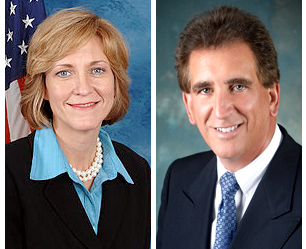
Sutton | Renacci


In Ohio’s only general election congressional race pitting two incumbent members against each other, a new poll reveals a very tight contest with tremendously high stakes.

A GBA Strategies internal poll (July 15-19; 500 likely OH-16 voters; margin of error plus-or-minus 4.4 percentage points) conducted for Democratic Rep. Betty Sutton shows her to be in a statistical dead-heat against GOP freshman Rep. Jim Renacci. The data gives Sutton 42 percent as compared to Renacci’s 40 percent.

Surprisingly, Libertarian candidate Jeff Blevins is taking a sizable 12 percent of the sampled voters. This latter number causes some to question the poll’s methodology because, for a sole independent candidate, these figures are much higher than what is normally seen. Third-party candidates have shown to typically under-perform in their poll results, so it is likely his actual vote total will return to the low single-digit percentages that are normally recorded for such candidates. Interestingly, GBA projects Blevins to be drawing his support equally from both Democrats and Republicans.

The current results show little change from GBA’s October poll that projected the race to be tied, with each candidate attracting 45 percent of the vote. Blevins, however, was not factored into the earlier poll. The numbers are also in line with a June poll from Normington Petts & Associates, a Democratic survey research firm, that found Sutton to be leading Renacci 41-38 percent. In July, the Democratic-leaning House Majority PAC further confirmed Sutton and Renacci were statistically tied at 40 percent, with Blevins taking a much smaller share of the vote.

The 2011 redistricting plan paired Sutton and Renacci as a result of Ohio losing two congressional seats in reapportionment due to slow population growth. With a Republican legislature in control of the redistricting pen, the two were placed in a seat that favors Renacci in a head-to-head race with Sutton. Renacci carries over 41.8 percent residents from his current seat, while Sutton has far fewer constituents in the new 16th. Her carry-over figure is half that of Renacci’s, at 20.6 percent.

With polling leaving us in a statistically deadlocked race, we turn to the importance of spending and fundraising. Renacci was the stronger fundraiser last quarter according to the latest Federal Election Commission financial disclosure reports (closed June 30). He reported raising approximately $502,000 compared to Sutton’s $293,000. Additionally, Renacci ended the quarter with approximately $1.5 million cash on hand, compared to Sutton’s $900,000. Contrary to 2010 when the Republican self-contributed more than $752,000, this year he has only invested $2,500 into his re-election campaign.

Both campaigns and outside liberal and conservative groups already have reserved millions of dollars in TV advertising time in the Cleveland media market. Groups such as the Democratic Congressional Campaign Committee (DCCC) already have reserved over $3 million in Cleveland ad time and similarly the National Republican Congressional Committee (NRCC) as well as other groups has reserved $2 million buys thus far.

This member vs. member match-up has been a tight battle since the seat was redrawn and guarantees to be a horse race until the end. Both candidates have the experience, resources, outside support, and staff to run strong campaigns. OH-16 is considered to be a top race for both the DCCC and NRCC this fall, so stay tuned.

Weekly Redistricting Update

Today’s spotlight takes us to southern California to underscore just how much difference redistricting and election law changes can make in campaign strategy. The new CA-26 was deliberately designed as a 50/50 seat, and the state’s novel primary law is forcing the Democratic Congressional Campaign Committee (DCCC) into making some rather unorthodox spending decisions.

CALIFORNIA (current delegation: 34D-19R) – The new 26th District is fully contained within Ventura County, which sits between cities and counties of Los Angeles and Santa Barbara. According to the latest census count, Ventura has 823,318 residents, which makes it a major political division. The new 26th was designed with the idea of creating a marginal district that would remain competitive throughout the decade. As an open seat, because Rep. Elton Gallegly (R-CA-24) is retiring, the district appears to be performing as intended.

Sixty-four percent of the district’s territory comes from Gallegly’s 24th District. Thirty-five percent is added from Democratic Rep. Lois Capps’ 23rd CD, with just a sliver from Rep. Henry Waxman’s (D) current 30th (1 percent). Though President Obama captured 56 percent of the vote here in 2008, the 2010 numbers tell a completely different story. In the governor’s race, Democrat Jerry Brown, the eventual winner, came up one point short in the 26th, as Republican Meg Whitman nipped him 47-46 percent. Republican Carly Fiorina came in ahead of Sen. Barbara Boxer (D) by an almost identical 47-45 percent spread. Finally, to counterbalance the Obama double-digit win, the Republican candidate for Attorney General, Steve Cooley, notched a 49-38 percent score against Democrat Kamala Harris, the statewide winner by less than half a percentage point.

In addition to redistricting, the other major California electoral change concerns how the state nominates candidates for the general election. Instead of featuring a closed primary election system that sends one Democrat, one Republican, and multiple Independent candidates to the general election, the new system puts forth only the two top vote-getters regardless of political party affiliation. The new procedure is creating havoc in District 26.

The Democrats were solidly behind their Ventura County supervisor, Steve Bennett, early in the race. Both the local and national party felt Bennett gave them their best chance of attaining victory in the marginal seat. After officially entering the race, Bennett decided to return to local government instead, and withdrew from the congressional campaign. This left the Democrats without a strong candidate until they were able to recruit three-term state Assemblywoman Julia Brownley; but the heart of her current legislative district is in Santa Monica and not Ventura County. For their part, Republicans coalesced around state Sen. Tony Strickland, who had twice been a statewide candidate.

It is the second supervisor in the race, Republican Linda Parks, who will test just how the new law works. Instead of running as a Republican, knowing that Strickland would take the majority of the GOP primary votes, she decided to declare herself as an Independent, thinking that this would be her best chance of snatching a run-off position away from the Democrats. Parks is a major Ventura County political figure, serving her third term on the Board of Supervisors after winning election as mayor of Thousand Oaks after serving on the locality’s city council. This contrasts heavily with Brownley, though representing some of Ventura County, who actually hails from Santa Monica in Los Angeles County – a point that Parks consistently reiterates.

The set-up here is forcing the DCCC to involve itself in the June election because they fear that both Strickland and Parks could qualify for the general, thus leaving them without a candidate in a seat that they can certainly win.

The DCCC is therefore actively communicating with voters, sending mailers that “Photoshop” Parks into a setting with Republican leaders such as Sarah Palin and former president George W. Bush. Others drive home the point to Democratic voters that Parks is actually a Republican. But Parks counters by highlighting other campaign messages from her previous opponent, ironically Sen. Strickland’s wife, Audra, who challenged her for the board two years ago, that identified her as a liberal and being too aligned with the Democrats. Parks is cleverly juxtaposing both mail messages to prove that she is, in fact, independent because both parties have launched similar attacks against her.

Redistricting and the election law process were done to change the voting system in California, and it appears those goals have been accomplished. The developments in the 26th District until the June 5 qualifying election will be very interesting to watch. It is clear we are seeing unusual happenings here, which are expected to continue.

Is the DCCC Wasting its Money?

The Democratic Congressional Campaign Committee is already on the attack, running radio ads this week against 19 Republican incumbents whom they believe will be vulnerable next year. According to the message in most of the spots, the member in question is being attacked for supporting the Republican spending cuts, which the Democrats’ say will tangentially stifle job creation.

The problem for the DCCC is that in nine of the 19 targeted districts, Republicans have full control of the redistricting pen, and to a person these members will be running in much stronger GOP districts in 2012. In only two of the 19 will the Democrats be able to change the districts to enhance their own party candidates (in Illinois — Reps. Bob Dold and Joe Walsh). In the remaining seats, the Ds and Rs have split control meaning that a redistricting commission or a court ultimately will decide how the final lines are constructed.

Until redistricting is complete, it is difficult to fully grasp how the new congressional districts will form. Therefore, the DCCC may be paying to educate large numbers of constituents who won’t even be eligible to vote against their particular target in the fall of 2012. Likely, the more cost-effective, short-term advertising strategy for both parties is to demonstrate patience.
__________________________________________________
For further detailed insights, to sign up for my daily email updates, or to sign up to track specific issues or industries, please contact me at PR***@*******************ts.com.