
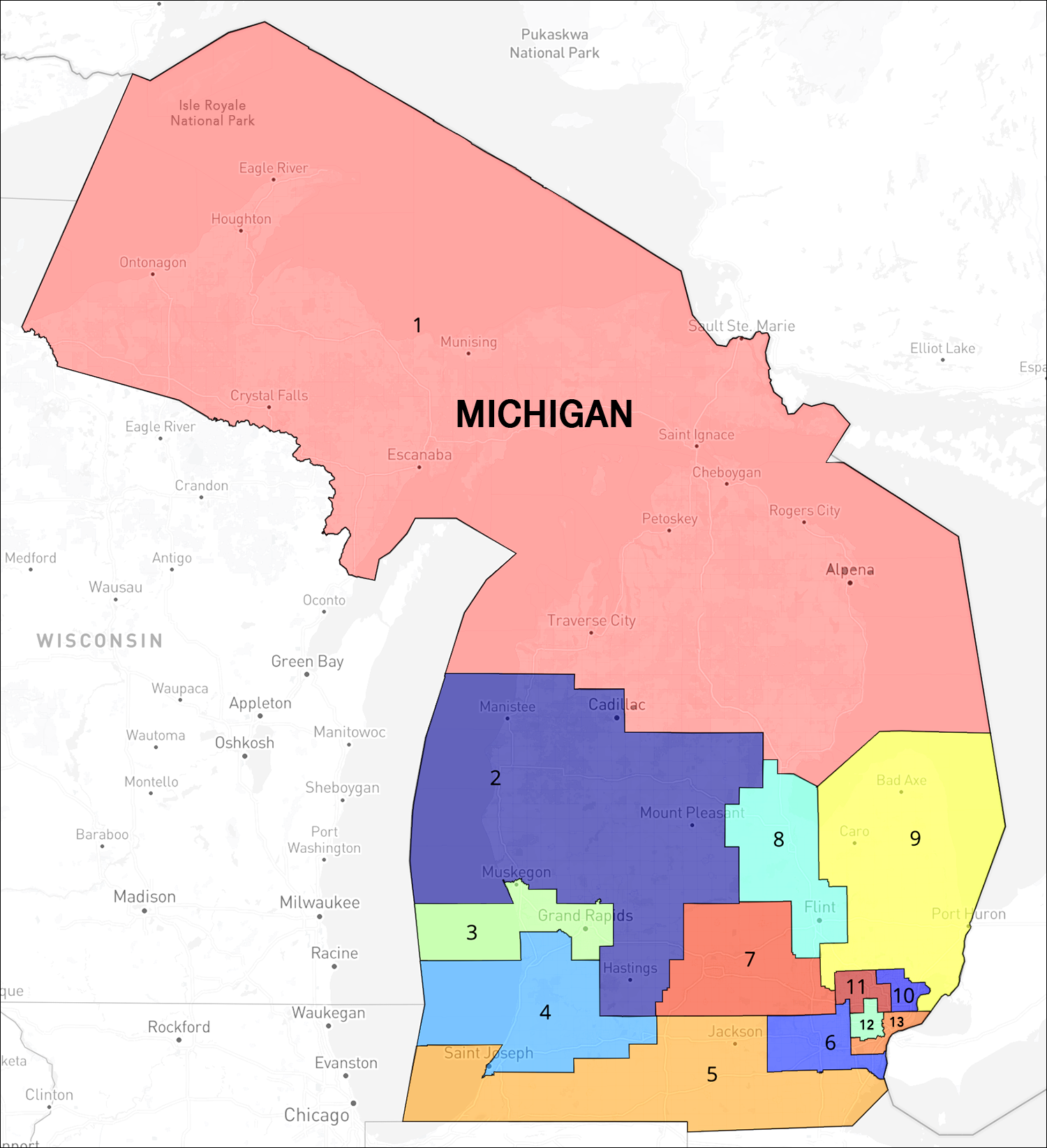
Michigan Congressional Map / To see interactive map, go to: Dave’s Redistricting App, Michigan
By Jim Ellis — Friday, Dec. 12, 2025
US House
While the most recent attention for flipping the US House has been devoted to the redistricting changes in California and Texas, a third state that did not redistrict will have an equivalent effect upon the 2026 national US House picture.
The Wolverine State of Michigan will be one of the hottest political states in the country for the 2026 election from the top of the ballot to the bottom. Because of the domain’s later April 21 candidate filing deadline and Aug. 4 partisan primary schedule, the early national political focus has been elsewhere, but such does not diminish Michigan’s importance as a ‘26 electoral player.
At the top of the ticket, and for the first time in the modern political era, Michigan will host an open Governor and Senate race in the same election cycle. In the House races, we could see major competition in five of the state’s 13 congressional districts. One of those CDs is open, and two others feature freshman members seeking their first re-election.
The Governor’s race will be unique in that it not only projects to be close, but three-term former Detroit Mayor Mike Duggan running as an Independent instead of a Democrat means we will see a competitive statewide campaign not just between two candidates, but three.
At this point, it appears that Secretary of State Jocelyn Benson and Rep. John James (R-Farmington Hills) will be the respective Democratic and Republican gubernatorial nominees. Incumbent Gov. Gretchen Whitmer (D) is ineligible to compete for a third term, but we are likely to see more of her as a probable 2028 presidential candidate.
Sen. Gary Peters (D) retiring after two terms has made the Michigan open Senate campaign one of the most competitive in the country and may be the Republicans’ best chance to convert a Democratic seat.
The latest published poll, from Mitchell Research & Communications (Nov. 18-21; 616 likely Michigan general election voters), projects Republican former Rep. Mike Rogers to small leads each over Rep. Haley Stevens (D-Birmingham), state Sen. Mallory McMorrow (D-Royal Oak), and former Wayne County Health Director Abdul El-Sayed (D). The latter three are already embroiled in a close primary that won’t be decided until Aug. 4.
The lateness of the Michigan primary is another break for Rogers since he is the prohibitive favorite for the Republican nomination and can stockpile resources for the general election.
The five competitive races that will have a major effect upon which party controls the next House majority begins in western Michigan with Districts 3 and 4.
In the Grand Rapids anchored 3rd District, which is rated as Lean Democratic (Dave’s Redistricting App partisan lean: 50.2D – 46.6R), Rep. Hillary Scholten (D-Grand Rapids), after briefly considering a Senate run, will seek a third term. Republicans don’t yet have a strong candidate capable of converting the seat, but this district is a top GOP recruitment priority.
In the 4th District, veteran Rep. Bill Huizenga (R-Holland), who seriously tested the US Senate waters before turning back under GOP party leadership pressure, has not yet officially announced that he will seek re-election in what again promises to be a competitive general election. In 2024, Huizenga won with a 55-43 percent majority against a weak opponent whom he outspent by a 3:1 ratio.
The Dave’s Redistricting App (DRA) partisan lean for CD-4 is 51.8R – 45.1D meaning the Republicans have a clear advantage but a strong Democrat would have a credible chance of securing an upset victory. Should Huizenga decide to retire, this race will likely go into toss-up mode. Democrats have four announced candidates including state Sen. Sean McCann (D-Kalamazoo), who is already polling close to Huizenga.
The area encompassing the cities of Flint, Lansing, and the northern Detroit suburbs will feature potentially the three hottest Michigan US House campaigns.
In the Lansing anchored 7th District, freshman Rep. Tom Barrett (R-Charlotte) was the only 2024 candidate to convert an open seat. He will now defend his position within a hot political climate in what promises to be one of the top national congressional campaigns. Six Democrats have announced their candidacies and the leading contender for the party nomination appears to be former US Ambassador to Ukraine Bridget Brink. The DRA partisan lean for this toss-up seat is 49.3D – 47.9R.
The Flint-anchored 8th CD saw Democrat Kristen McDonald Rivet (D), then a sitting state Senator, defeat three-time GOP congressional candidate Paul Junge by a 51-45 percent margin. The DRA partisan lean of 51.0D – 46.2R, however, suggests the race could have been a bit closer. Republicans have yet to file a top contender, but this contest will again be close and is, like MI-3, at the top of the GOP candidate recruitment list.
Rep. James departing the 10th District to run for Governor leaves what could become one of the closest open seat races in the country. The DRA partisan lean here is 49.5D – 47.9R which has led to two close James’ victories.
Both parties already have five announced candidates. Republicans feature Mike Bouchard Jr., whose father is the Oakland County Sheriff and a former statewide candidate, while Democrats see former US Commerce Department Eric Chung and Pontiac Mayor Tim Greimel as their current top candidates.
Potential Republican contenders include former Congressman Mike Bishop and ex-gubernatorial candidate Kevin Rinke. Much will happen in MI-10 before the filing deadline as the candidates and potential candidates continue to test the political waters.
Regardless of how the national redistricting wars end, the US House majority will likely come down to just a few seats. It is clear that Michigan will play a pivotal role in determining which party will ultimately claim control of the House chamber at the beginning of 2027.