
Category Archives: INDIANA

Indiana Joins Redistricting Battle

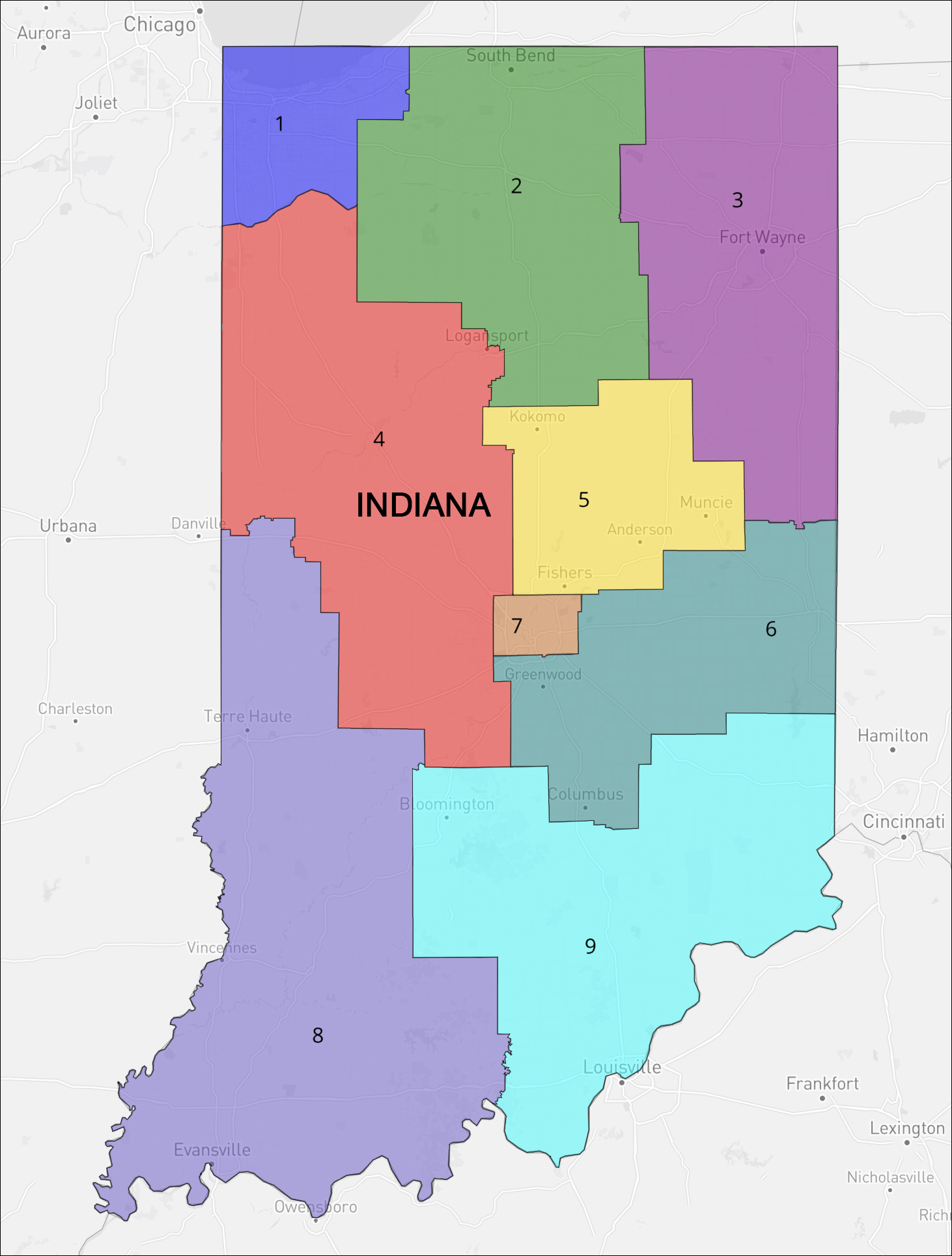
Current Indiana US House Congressional Districts map / Click on image to go to interactive version on Dave’s Redistricting App.

By Jim Ellis — Wednesday, Oct. 29, 2025

Redistricting

It appears we are seeing another state poised to join the mid-decade redistricting wars as an active participant.

Indiana Gov. Mike Braun (R) summoned the legislature back into session on Monday to work several issues and congressional redistricting is expected to be among them. It is now clear that Indiana will play a major role in how the new redistricting wave unfolds.

Developments favorable to Democrats in certain other states have now put selected Republican state leaders under further political pressure to attempt to neutralize those projected gains.

Indiana is one such place. Reports have been in the public domain for weeks saying that the White House, including Vice President J.D. Vance, who has met with Hoosier State legislative leaders on more than one occasion, have been overtly working to convince reluctant legislators to move forward. Gov. Braun has been supportive of the effort from the beginning.

Now, it appears we will see movement. The current Indiana congressional map features seven Republicans and two Democrats, but some believe the legislature could draw a 9R-0D map. Whether they go that far remains to be seen.

The Republicans’ obvious first target will be northwestern Indiana Congressman Frank Mrvan (D-Highland/Gary). His 1st District has become more competitive as evidenced by his lower than expected 53 percent average in his last two elections. Additionally, the Republican who ran strongly against Rep. Mrvan in 2022, retired US Air Force officer Jennifer-Ruth Green, is reportedly open to running again in a more favorable district.

The state’s other Democratic member is Rep. Andre Carson (D-Indianapolis), who has served nine full terms and part of another. Carson’s current 7th District is solidly Democratic (Dave’s Redistricting App partisan lean: 67.9D – 29.0R) meaning the new map would have to break his district into segments in order to create another Republican seat.

If the map-drawers pursue such a course, the pie-shaped format might be overlayed into the Indianapolis region. The pie-shape concept brings contiguous districts into a metro area sometimes for partisan reasons, though many point out that such a draw gives a particular metropolitan area more representation and thus the region has a stronger presence in Congress.

Should the Indiana legislators adopt such a strategy, Districts 4 (Rep. Jim Baird-R), 5 (Rep. Victoria Spartz-R), and 6 (Rep. Jefferson Shreve-R), would likely be fundamentally reconfigured. It is probable all of these districts would come into Marion County (only Rep. Shreve’s District 6 does now) to take a piece of Indianapolis city and non-city precincts, thereby stretching the 7th CD into more rural Republican areas.

Polling is now suggesting the California redistricting referendum will pass on Nov. 4 (latest released California survey: Emerson College — Yes 57, No 37). Therefore, Democrats could be in position to gain five Golden State seats according to the party’s projections.

Additionally, the Utah courts have ordered a redraw of that state’s congressional map because of a ruling saying the legislature, when constructing the current plan in 2021, ignored map construction criteria that voters approved in the previous decade. As a result, Democrats are likely to gain one seat from the Beehive State.

Therefore, Democrats will potentially gain six seats in California and Utah, and possibly one more if Maryland decides to redistrict.

There is also public discussion occurring indicating that Virginia could join the redraw fray if former Congresswoman Abigail Spanberger (D) wins the Governor’s race on Nov. 4. Even with a Democratic trifecta (Governor, state Senate, and state House of Delegates, which would occur with a Spanberger victory), redistricting would be no sure thing.

Virginia now has a hybrid redistricting commission composed of elected officials and citizens that have map drawing power. Therefore, the legislature will have to change the state’s redistricting structure in order to replace the current map. If they find a way, however, the Democrats could certainly make gains in the state since Republicans now hold five of Virginia’s 11 congressional districts.

Republicans would still come out ahead toward their goal of expanding the GOP Conference despite the aforementioned Democratic gains, however. It is probable that five seats would come from Texas, one on Missouri’s new map, one from North Carolina, all of which are complete, and further possible additions from Indiana as discussed, Florida, and Ohio (gaining two in each state). Louisiana and Alabama would likely follow suit if the Supreme Court eventually upholds the lower court ruling on the case currently before the justices.

Rep. Hollingsworth to Retire;
Tennessee Map Advances

By Jim Ellis

Indiana Rep. Trey Hollingsworth (R-Jeffersonville)

Jan. 14, 2022 — Three-term Indiana Rep. Trey Hollingsworth (R-Jeffersonville) announced Wednesday that he will not seek re-election in the autumn, becoming the 12th Republican to retire in this election cycle. The congressman’s retirement decision means at least 46 seats will be open in the 2022 House election.

Saying, “I ran for Congress to return this government to the people from the career politicians who had broken it, and I will be damned if I become one in the process,” Hollingsworth will draw his congressional career to a close after six years. When he first ran in 2016, he pledged to serve no more than four terms. He expresses a desire to return to the private sector.

Indiana’s 9th District occupies most of the state’s southern sector and for years was a Blue Dog Democratic area. For 17 terms, Congressman Lee Hamilton (D), who became chairman of the House Intelligence and Foreign Affairs Committees, represented the district. Democrat Baron Hill succeeded him in 1998, and served until his defeat at the hands of Republican businessman Mike Sodrel in 2004. Two years later, Hill recaptured the seat and held it until his second loss in 2010, this time to attorney Todd Young (R) who is now the Hoosier State’s senior senator.

Since the Young victory in 2010, the 9th has performed as a solid Republican district. Donald Trump carried in the seat in 2016 with a 61-34 percent margin, and again in 2020 with a similar 61-37 percent vote spread.

Under the new Indiana congressional map, the new 9th moves to the north and east, but retains its population centers in Jeffersonville, Clarksville, and New Albany, all across the Ohio River from Louisville, KY, and in the college town of Bloomington where the Indiana University resides.

Dave’s Redistricting App rates the new seat as a 59.7 percent Republican domain, while the FiveThirtyEight statistical site projects the new IN-9 with an R+30 rating, up from R+27 on the current map. The Republican primary is expected to be crowded and competitive. The Indiana candidate filing deadline is Feb. 4 for the May 3 statewide primary.
Continue reading

Post Redistricting:
Competitive Seats, Part I

Click on interactive map above to see Illinois Congressional Districts

By Jim Ellis

Dec. 9, 2021 — Redistricting has now been completed in 20 multi-congressional district states, so this is a good time to examine the races viewed as competitive in the places with new district boundaries. Today, we look at domains from Alabama through Massachusetts. Part II will include the second half of the alphabet.


Alabama:

The Alabama legislature and Gov. Kay Ivey (R) completed their work and delivered a plan similar to the 6R-1D map that is currently in place. At one point, it appeared Alabama would lose a congressional seat, but such proved not the case. Therefore, redistricting became relatively simple in a state where Republicans dominate politically.

Rep. Terri Sewell’s (D-Birmingham) Voting Rights seat was the most under-populated CD needing 53,143 individuals to meet Alabama’s 717,754 per district resident quota. Such a people swing was easily completed because Reps. Mo Brooks’ (R-Huntsville) 5th District and Gary Palmer’s (R-Hoover) 6th CD were over-populated.


Arkansas:

The state’s new four-district congressional plan easily passed the Republican legislature, but was enacted without Gov. Asa Hutchinson’s (R) signature. The main change was making Rep. French Hill’s (R-Little Rock) 2nd District more Republican. The map is likely to continue performing favorably for all four Republican incumbents.


Colorado:

The Colorado Independent Redistricting Commission was the first entity to complete the new maps, and with the state Supreme Court giving final approval in late October, it is unlikely that we will see lawsuits being filed. The map gives all seven current incumbents a place to run with only Rep. Ed Perlmutter’s (D-Arvada) 7th District becoming substantially more competitive. Perlmutter will still be the clear favorite to win again next November, but his current 60-37 percent Biden district is gone.

The major difference for the coming decade is the addition of a new 8th District, and the commission members decided to make this seat competitive. Sitting north and northeast of Denver and encompassing the cities of Thornton, Westminster, and Greeley, this new district gives the Democrats only a slight one-point advantage. In 2022, this seat will certainly be in play for both parties.


Georgia:

The legislature and Gov. Brian Kemp (R) recently approved a new congressional map that may net the Republicans a gain of one seat. The big difference comes in the northern Atlanta suburbs.

Returning Rep. Lucy McBath’s (D-Marietta) 6th District to a Republican domain sees her declaring for re-election in the adjacent 7th District where she will face freshman Democratic Rep. Carolyn Bourdeaux (D-Suwanee) in a primary battle. Also in the race is state Rep. Donna McLeod (D-Lawrenceville) who says she is the only candidate who actually lives in the district.

The new 7th contains more of Rep. Bourdeaux’s territory, but McBath likely has the stronger ideological base. This will be a tight and hard-fought nomination contest, but the winner earns a safe Democratic district for the general election.


Idaho:

The Gem State was the nation’s second fastest-growing entity in the previous decade, but they did not gain a third congressional seat. The map drawers only needed to swap 35,338 individuals from Rep. Russ Fulcher’s (R-Meridian) 1st District to Rep. Mike Simpson’s (R-Idaho Falls) 2nd CD in order to meet the state’s huge 919,513 per district population quota, the largest in the nation.

Should the Idaho growth trend continue in its current pattern, expect the state to earn a third district in the 2030 reapportionment. This map will remain safely 2R-0D.


Continue reading

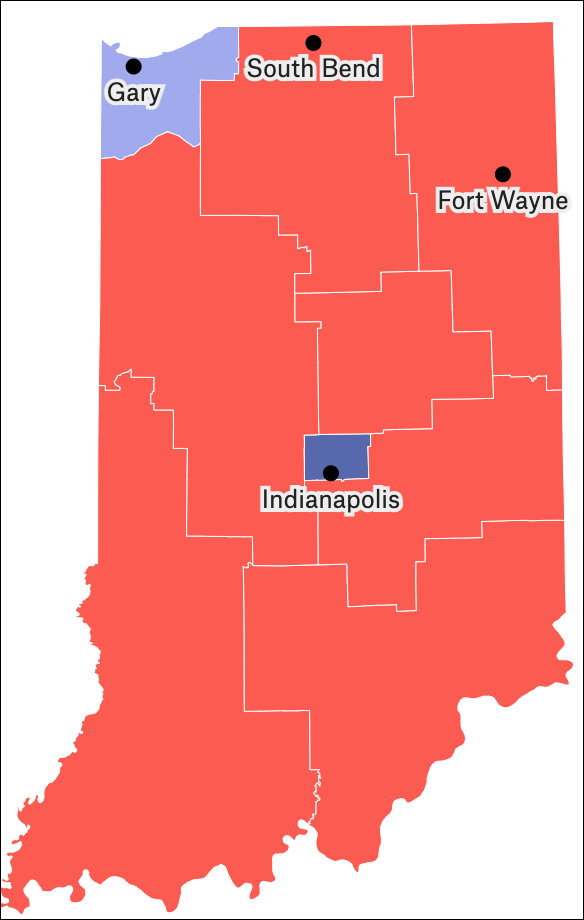
INDIANA REDISTRICTING UPDATE

FiveThirtyEight.com

Gov. Eric Holcomb (R) signed the new congressional redistricting legislation in early October, becoming one of the first states to complete the decennial re-drawing process.

The main change in the nine-district map was to make freshman Rep. Victoria Spartz’s (R-Noblesville) seat more Republican by sending the previous 5th District’s Marion County precincts to other congressional districts. The Spartz seat was the most over-populated district in the state, having to release 50,921 individuals to other districts. Therefore, this district became the focal point of the new map.

The Indiana legislature drew a map that should return a 7R-2D delegation to Washington for most, if not all, of the current decade.