
By Jim Ellis — Tuesday, March 24, 2026
Senate
A new poll suggests that the Idaho Senate race may become the 2026 version of what we saw unfold in Nebraska two years ago.
In the 2024 Cornhusker State US Senate election, Independent Dan Osborn was able to garner the Nebraska Democratic Party’s support, and with strong fundraising catapulted himself into a competitive battle with Sen. Deb Fischer (R). In the end, Sen. Fischer prevailed with a six-point victory margin, but not without enduring a period where several consecutive public polls staked Osborn to a lead.
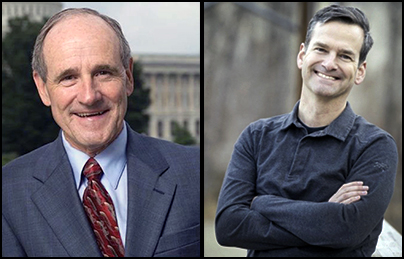
Left: Three-term Idaho incumbent Sen. Jim Risch (R). Right: Challenger Todd Achilles, a former Democratic state Representative
Apparently, the incumbent’s age will be an issue. Risch will be 83 at the time of the election, and his long career in elective politics appears to be an Achilles talking point as the campaign begins in earnest.
Risch was elected to the US Senate in 2008 after serving for seven months as Governor before returning to his position as Lieutenant Governor. Prior to winning statewide office, Risch served 21 non-consecutive years in the Idaho Senate. Except for a six-year stint when he was out of elective politics, Sen. Risch has been in public office continually since the end of 1974.
In an interview with the Idaho News, a left-leaning website covering Boundary County located at the northernmost point of the Idaho Panhandle that borders Canada, Achilles said, “voters want a Senator who will stand up to monopolies, defend free markets, protect small businesses and producers, safeguard families online, and remain sharp and effective for the full six-year term.”
The Achilles Senate effort should be taken seriously. According to his claims, the Independent candidate has “nearly 1,000 volunteers and attended more than 100 events that cover all 44 Idaho counties.” He also has raised $350,000 for his statewide effort, but that amount compares poorly to Sen. Risch’s reported $3.87 million year end cash-on-hand figure.
On the Senator’s side is his campaign history. Counting his two bids for Lieutenant Governor and three US Senate contests, Risch has won every statewide race in which he has participated. In those five campaigns beginning in 2002, he has averaged an even 60.0 percent of the vote and has a strong base of support within the Republican Party.
Candidate filing closed March 6, and Sen. Risch drew only three minor Republican primary opponents: data engineer Joe Evans, construction contractor Danny LaVe, and paper mill operations supervisor Josh Roy.
What may hurt Achilles’ effort in the general election is the Democrats having their own nominee. Realtor David Roth is unopposed for the Democratic US Senate nomination and will advance into the general election, though he will have little in the way of resources with which to compete.
While Achilles, who resigned from the state House to devote full time to his Independent bid for the Senate, is clearly making a serious effort to construct a competitive campaign, he will need the Democratic leadership to force their eventual nominee out of the race so the party could endorse, or at least not impede, his stronger Independent effort opposite Sen. Risch.
Such a Democratic move, however, might prove to be a two-edged sword. While the Democrats not having their own nominee would help Achilles evolve the race into a two-way affair, the party leaders officially endorsing the Independent would hurt his ability to carve the centrist ideological path that he desires, especially since he served as a Democrat in the state House as recently as July.
While the PPP poll suggests that Sen. Risch may not be as strong as one would have believed when first glancing at the 2026 national Senate political card, Achilles still faces a difficult task of putting this race into play even though he is constructing a credible early effort.
Accounting for the most obvious positive and negative factors, Sen. Risch must still be regarded as the determinative favorite for re-election.