
By Jim Ellis — Tuesday, February 17, 2026
ICE & Minnesota
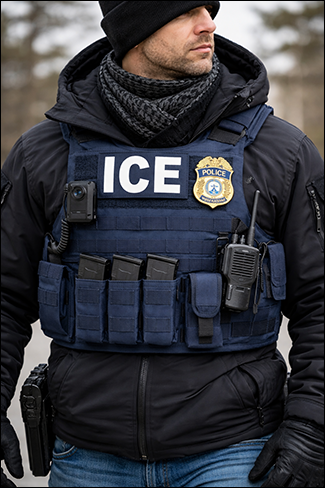 A new Emerson College political survey suggests that the adverse publicity from the ICE controversy in Minneapolis may not be favoring Democrats to the degree one might have anticipated considering the intense media coverage surrounding the issue.
The Emerson College poll (Feb. 6-8; 1,000 likely Minnesota general election voters; multiple sampling techniques) actually finds that a plurality of the Minnesota poll respondents do not support abolishing ICE (42 percent in favor; 46 percent opposing), and recently recruited US Senate candidate Michele Tafoya (R), a former national sportscaster, trails in a general election ballot test by only six percentage points.
Tafoya fares basically the same when individually paired with both Lt. Gov. Peggy Flanagan (D) and Rep. Angie Craig (D-Prior Lake): 47-41 percent against Flanagan, and 47-40 percent opposite Craig.
Not surprisingly, as he is nationally, President Trump’s approval rating is upside-down, largely due to the ICE situation and negative perceptions about the economy. His Minnesota favorability index is 39.1 – 56.3 favorable to unfavorable.
Gov. Tim Walz’s (D) approval is also in negative territory (41.4 – 47.0 percent), and that is largely because of the public assistance program fraud scandal, a story that has temporarily disappeared because of the ICE coverage, but one that will certainly return during the campaign.
Sen. Amy Klobuchar (D), who is running for Governor, is positively regarded but not overwhelmingly so with a 48.1 – 40.7 percent favorability index. While Tafoya is already running relatively close to her potential Democratic opponents in the Senate race, Sen. Klobuchar posts positive ballot test results of more than 50 percent against two potential Republican opponents, state House Speaker Lisa Demuth (51.1 – 37.7 percent), and My Pillow company owner and spokesman Mike Lindell (52.8 – 30.9 percent).
Though Minnesota is the most loyal Democratic state in presidential campaigns – the last Republican national nominee to carry the domain was Richard Nixon in 1972 – the partisan divide is not in landslide proportions. In fact, through President Trump’s three campaigns, the combined Democratic nominees, Hillary Clinton, Joe Biden, and Kamala Harris, averaged 49.9 percent of the vote. For his part, Trump recorded an average support figure of 45.6 percent over the same three elections.
While the Democrats control all of the statewide positions in the Land of 10,000 Lakes, the congressional delegation is split evenly at 4D – 4R. In the legislature, Democrats have only a one seat majority in the state Senate, and the state House of Representatives is tied between the parties.
The Dave’s Redistricting App statisticians calculate a statewide partisan lean for Minnesota of 51.3D – 43.2R, but the Republican lean number still surpasses the Democratic figure in four of the eight congressional districts.
Another indication that the state could become more competitive than recent statewide election results suggest is the responses to the ICE and immigration questions on the Emerson College poll.
While the respondents certainly believe that the ICE presence in communities has been more harmful (60.2 percent) than beneficial (36.2 percent), a plurality of the survey participants (42.3 percent) would not only oppose disbanding ICE, but they also favor the Trump Administration’s immigration policies to that of the Biden Administration (35.0 percent).
The Republican leadership recruiting Tafoya, a well-known sports broadcasting figure in Minnesota throughout her entire career, appears as a strong move.
With the Democrats making offensive moves in the North Carolina, Maine, Texas, Ohio, and Alaska Senate races, Republicans need to expand their conversion opportunities beyond Michigan, New Hampshire, and Georgia. A competitive run from Tafoya in Minnesota could significantly boost their already strong chances of holding the Senate majority.
The Democrats would have to win four of their five top conversion opportunities to secure a bare Senate majority. They are attempting to expand their target list by adding Iowa, Nebraska, and Kansas to improve their chances. Conversely, Republicans even taking one Democratic seat away would more than likely seal their majority for another two years.
The initial Emerson College Minnesota poll suggests the state could soon ascend the national Republican Senate target list and become a race to watch.
