
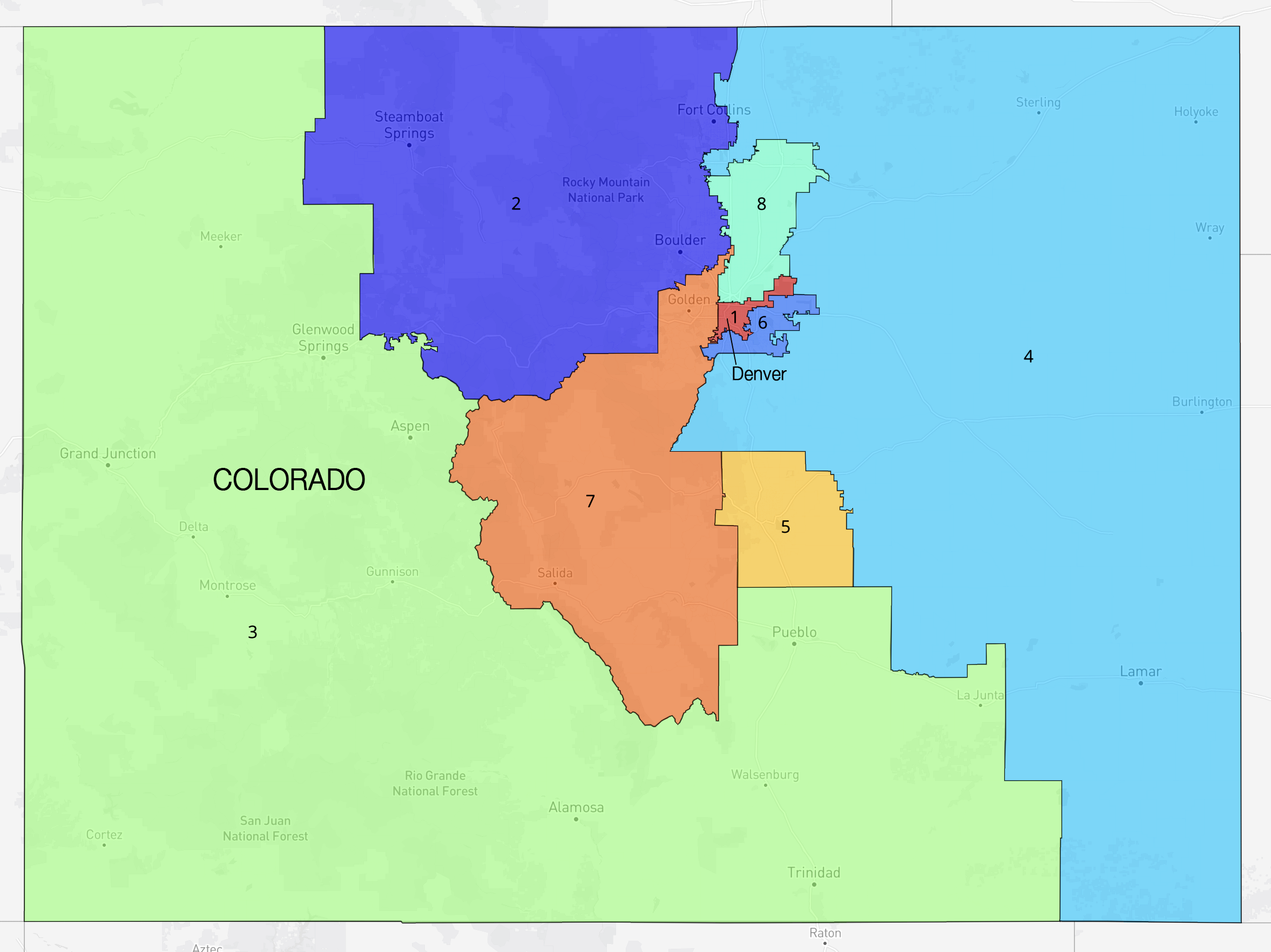
Colorado Congressional Districts / Dave’s Redistricting App interactive map
By Jim Ellis — Monday, February 23, 2026
Redistricting
Yet another state is making a redistricting move, but this one is for the future.
A new organization called Coloradans for a Level Playing Field announced this week that it will attempt to qualify a congressional redistricting ballot proposition for the November 2026 ballot. The proponents will encourage the electorate to enact a new map designed to create the exact opposite effect of their stated name.
The outline of the suggested redistricting map would reduce the Republicans to just one of the state’s eight congressional seats, into a 7D-1R split. Currently, the Colorado delegation is split 4D-4R. If the group organizers are successful in qualifying their initiative and the measure passes, the new map would take effect for the 2028 and 2030 election cycles.
The current Colorado Independent Redistricting Commissions’ congressional panel members constructed the current map in 2021. Some consider the Centennial State redistricting process as a model for other places. Citizens are chosen to create maps in accordance with Colorado redistricting statutes, and when pertinent, federal redistricting law.
Once an assigned panel agrees upon and formally passes a map, the plan is automatically sent to the state Supreme Court for approval. Adding the court to the formal procedure has resulted in no filed lawsuits against any of the commission maps because Colorado’s ultimate redistricting authority declared the legality of the plan(s) at the outset.
The Colorado system also features a different group of citizens being chosen to draw individual maps, meaning the plans for Congress, state Senate, state House, and any other body that elects its members through districts.
The fledgling Level Playing Field organization, backed financially by Democratic Party sources, is floating four different proposals, and the leaders say they will soon formulate their final strategy and submit one map to the Secretary of State. Once the proposed ballot language is approved, the group then must recruit 124,238 valid registered voter signatures to qualify the referendum.
The other alternative for approving a proposed referendum is through the legislature and obtaining a required two-thirds votes for passage in each chamber. Democrats, however, are slightly below having a two-thirds majority in both houses, meaning their chances of prevailing at the state capitol are less than favorable.
The released map proposal, if adopted as publicized, would change three Republican districts, those of Reps. Jeff Hurd (R-Grand Junction), Jeff Crank (R-Colorado Springs), and Gabe Evans (R-Ft. Lupton) from safely Republican or toss-up seats (the latter in Rep. Evans’ case), into likely Democratic districts.
Ironically, the only Republican member that the Democrat-funded map drawers would concede to a GOP member is the state’s eastern 4th District of Rep. Lauren Boebert (R-Silt), likely the Level Playing Field leadership’s least favorite incumbent.
Under the proposal most likely to surface as the final map, Rep. Hurd’s district would transform from a 52.6R – 43.3D district according to the Dave’s Redistricting App statisticians into a western Colorado CD that would feature a virtually opposite 51.1D – 46.2R split. The change adds Democrats from Rep. Joe Neguse’s (D-Lafayette) 2nd District that would bring the new 3rd geographically closer to the outer Denver suburbs.
Rep. Crank’s 5th CD would move from a 56.1R – 38.9D partisan lean to one that yields a 52.2D – 45.0R split. The move here would also drive the Colorado Springs-anchored district much closer to Denver, taking Democrats mostly from Rep. Brittany Pettersen’s (D-Lakewood) 7th CD.
Finally, involving perhaps the most politically marginal district in the country, Rep. Evans’ 8th CD located north and east of Denver with a partisan lean of 48.3D – 47.0R, would become decidedly Democratic, brandishing a new 53.0D – 44.1R partisan division.
Finally, the changes would push the Republican factor in Rep. Boebert’s district even higher. Currently, the 4th District partisan lean is 60.3R – 35.9D. The new map increases the Republican figure to 63.3 with a corresponding Democratic benchmark of 34.3. Extra Republicans were added to this district from Rep. Crank’s 5th CD to make the latter seat more Democratic.
The Colorado redistricting initiative process has a long way to go and qualifying a new map for a ballot referendum this year is no certain task. If successful, the new congressional map will be in place for the 2028 and 2030 elections with the Colorado Independent Commissions process returning to draw a new post-census 2032 map that will be designed to last through the ensuing decade.