
By Jim Ellis — Thursday, February 26, 2026
House
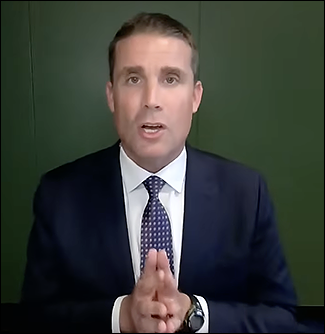
Former California state Senate President Mike McGuire
It was reported that former state Senate President Mike McGuire (D-Sonoma County) announced his special election candidacy. His move brings political risk that need not be undertaken. If McGuire simply remained in the Senate and ran only for the regular term he would be considered a prohibitive favorite, but not so for the special election.
When Gov. Gavin Newsom (D) announced last August that he would convince the legislature to schedule a redistricting referendum to pass a congressional map in order to negate what a new Texas plan might do for Republicans, then-state Senate President McGuire became the central figure in delivering the two-thirds majority in his chamber necessary to schedule the special referendum election and provide support for Newsom’s bold move.
The voters had to approve the irregular redistricting plan because the process was usurping the California Citizens Commission map enacted in 2021. Therefore, both legislative and public approval were required.
Sen. McGuire, ineligible to seek re-election in 2026 because of state term limits, wanted to change the 1st District, which was safely Republican under the Commission map, into a Democratic seat that he could win. Hence, altering the 1st District to McGuire’s liking became the price for passing the mid-decade redistricting referendum legislation.
Instead of a 1st District under the Commission map that read 60.2R – 37.7D and occupied the territory in the northeastern corner of the state that Oregon and Nevada bordered, the new 1st is anchored in Sen. McGuire’s home county of Sonoma and encompasses Democratic territory in the outer Sacramento suburbs. The new 1st CD’s partisan lean is 55.2D – 44.1R.
On Jan. 6, seven-term 1st District US Rep. Doug LaMalfa (R) suddenly passed away. His death leads to a special election that will be held concurrently with the state’s June 2 statewide primary election.
The first question the special election posed was whether the vote would be held in the 2021 version of the 1st CD or the new version. Because the special election would be for the purpose of filling the term that began in 2025, the 2021 map was determined as the correct venue.
Immediately, state Assemblyman James Gallagher (R-Yuba City), who, like Sen. McGuire is reaching the end of his allotted time in the legislature (in California, members can serve six-two year terms in the Assembly or three four-year Senate terms, or a combination not to exceed a combined 14 years), announced that he would compete in the special election. He has yet to state that he will run later this year in the new Democratic district.
Rather surprisingly, Sen. McGuire announced that he, too, will enter the special election. The move is questionable because the 2021 CD-1 is strongly Republican; therefore, he would be considered the underdog to Gallagher. Sen. McGuire would then turn around and seek election in the new 1st CD, regardless of the special election outcome.
The move adds political risk to McGuire’s personal congressional plan, especially since the special election winner will only serve a few months. Should McGuire lose to Gallagher in the special, the former’s air of invincibility for the new seat might be punctured and he will likely have adjusted some issue positions in his attempt to win in conservative territory that might hurt him when campaigning in the new liberal district.
Thus, his losing might make transitioning into the Democratic 1st District during the regular election more difficult. As a result, the move might give Gallagher or another Republican a better chance against McGuire in the regular election even though they will all compete in what should be a reliably new Democratic district.
Under California special election law, all candidates are placed on the same ballot in jungle primary form. Should a contender receive majority support in the first vote, the individual would be elected and immediately take office. If no one receives 50 percent or above, the top two finishers would advance to a runoff election on Aug. 4.
Candidate filing for the special election will conclude on April 9. Currently, the only other candidate to announce for the seat is non-profit organization consultant Audrey Denney (D).